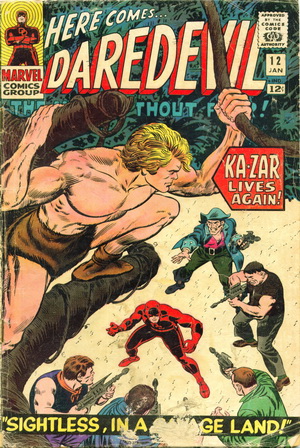
Published: January 1966
Script: Stan Lee
Layouts: Jack Kirby
Illustrations: John Romita
Letters: Sam Rosen
The frantic pace for this entire issue is set early when Murdock has only five minutes to get to the cruise ship Odyssey on the other side of town. No problem! He simply transforms to Daredevil and skips all the traffic. Of course, my first thought is…five minutes?? Really?? Nowadays we’re told to arrive at the airport two to three hours before our flight! Is the discrepancy due to it no longer being the 1960’s, or because we’re not superheroes? (Or, as I’m apt to suggest… “a little of both”?)
The frantic pace continues when, in the middle of watching a piratic plunder of the Odyssey, we suddenly switch scenes to see Ka-Zar of the jungle wrestling a Tyrannosaurus Rex. What does this have to do with anything? How in the world will Stan link these events? We’re overwhelmed by a sense that anything can happen…and probably will.
BREAKING OFF MORE THAN YOU CAN CHEW
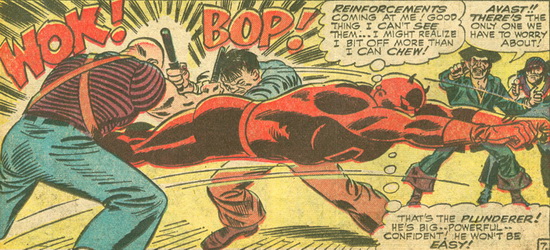
To further unsettle the reader, as Daredevil battles the pirates, he wonders if perhaps he has broken off more than he can chew. Frankly, I’m wondering the same of the writer. This story is all over the place! Before we’re done, we’ll have explored the worlds of pirate ships, submarines, noble villains, Tarzan, Transformers, the prehistoric age, swamp men, and Maa-Gor, the Ape Man!
You know that famous cliché about “everything but the kitchen sink”? The image kicked in when I finally reached the last page. What doesn’t this story have? Recently, I’ve noticed that Marvel’s storytelling is becoming more complex and elaborate. Reading this Daredevil, I suspect this approach is not a one-off, but rather the beginning of a trend.
NOT AS IT APPEARS TO BE
This kind of sophisticated storytelling easily lends itself to situations where everything is not at it first appears to be. Personally, I’m terrible at telling jokes and have only managed to maintain a dozen or so in my brain, but one of my favorite comedy bits is this monologue by Jerry Seinfeld:
This so resonates with me because more times than I care to admit, I am that person wondering, “Who was that guy? Wasn’t he with them?…Oh! He wasn’t really with them…” When things are not what they seem to be, that’s fun…to a point. But when it’s done ad nauseum, my desire for an orderly universe will eventually kick in. I’ve resigned myself to the fact that I will never fully understand what’s going on in a Mission: Impossible or Bourne movie, but hey, it’s only two hours, and very bright and shiny, so rather than succumb to frustration, I simply make a deliberate effort to just sit back and enjoy the action.
And, as much as I hate to admit it, some of the recent Marvel offerings on Disney+ also tax my patience a bit. A series demands a greater commitment of time, so I don’t tolerate the confusion as well as I do in a simple two-hour movie. Which disappoints me. Because I want to enjoy everything Marvel does. (But maybe that’s an unreasonable expectation?)
So far I’ve been able to keep up in Marvel Comics. I’m just hoping that as time goes on, these printed stories from simpler days won’t overplay the double/triple agent, time travel, villain in disguise storyline motifs so often that I’ll be tempted to give up in utter frustration.
 Now. While it’s true that I can find some storylines challenging, I’m much more appreciative of a complicated character. And in this story, some of our characters in and of themselves are not exactly what they first appear to be. And that sparks my interest. Sometimes a character develops over time and circumstance, and sometimes they are merely slowly revealed, as in the peeling of an onion. Some onions will make you cry, but others prove very tasty.
KA-ZAR
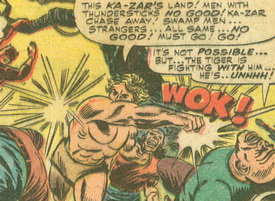
Let’s take Ka-Zar, for instance. At first he appears nothing more than a Tarzan clone—but a closer look uncovers a fascinating nuance. Yes, of course he’s noble (like Tarzan), as we’ll see later in the story when he decides to risk all to help his opponent Daredevil. But studying Ka-Zar’s speech patterns reveals something interesting. In the presence of other men, he tends to talk like Hulk, in short, stilted sentences:
But now note how, alone in his thoughts, or talking to his trusted ally Zabu, his speech patterns almost verge on the Shakespearean:
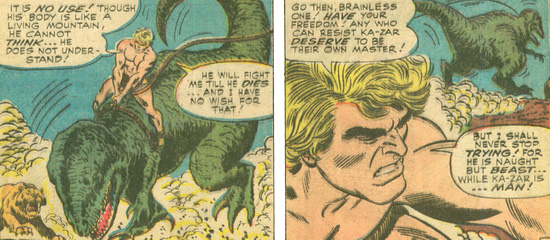
Quite a difference, right? Could it be there is more to our jungle man than meets the eye? Perhaps he is putting on a big dumb muscleman persona to throw his opponents off-guard? In other words, is our “big dumb muscleman” smart enough to hustle his opponents? Hmmmm…I’m intrigued by the possibility.
CAPTAIN PLUNDER
Now let’s consider Captain Plunder, who provides even more fascination as his character is slowly revealed over several pages. At first I suspected Plunder would be a fairly two-dimensional character. After all, his name sounds more like a cleaning product than an actual name. More likely though in this Marvel Universe, we can easily suspect his simple moniker is merely a code name identifier for a simple villain who identifies with a single act or characteristic: Mole Man, Sandman, Doctor Octopus, the Puppet Master, etc.
But quickly we learn that Plunder is in fact his actual name. That is, if we can trust him. He is, after all, a villain, and these are not usually the most trustworthy of characters. But giving him the benefit on the doubt, let’s go along with his story that he is indeed Lord Parnival Plunder. How delightfully interesting! First question of course: Did he only take up piracy because his name dictated it? After all, Otto Octavius became Doctor Octopus. I once lived in a town that had a chiropractor named Dr. Fruithandler (I kid you not). Shall we anticipate that Sen. Sheldon Whitehouse will run for election to a higher office? Is this the universe’s way of steering you into the inevitable?
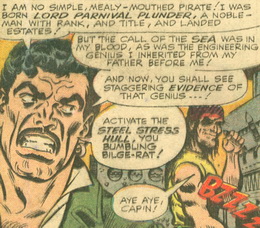 Plunder certainly seems interested in monetary gain early in the story, when he describes the cruise ship Odyssey as “what a prize,” and leads the boarding party with cries of “Empty your pockets!” But he abandons all that when he decides to take nothing more than Daredevil as hostage. Then, to Daredevil, he finally reveals his true motivation: Pride and Revenge toward all those who laughed at his dreams!
Plunder is a sort of evil twin to Tony Stark Money is apparently no problem, and he inherited his engineering genius from his father. They even look alike. If Stark went over to the Dark Side, Plunder is what you’d get. I would not be at all surprised to find a FanFiction in which Stark and Plunder turn out to be long-lost twin brothers.
Any takers?
MUTUAL ADMIRATION SOCIETY
So, with all these revelations, it’s not surprising that our characters’ opinions of each other also transform during the course of the story, and eventually we have a couple of full-blown Mutual Admiration Societies going on. It appears Daredevil makes friends wherever he goes, turning the hearts of his enemies towards respecting him—as he also learns to respect them.
First, Captain Plunder so admires Daredevil’s abilities that he forsakes his original intention of plundering the cruise ship for monetary gain. Instead he decides to sell all he has (or, in this case, might have) to purchase a single field that contains a hidden treasure. 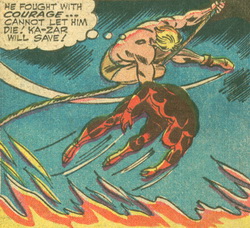 And Daredevil, upon hearing Plunder’s story, decides the pirate is actually noble.
Then we have Daredevil and Ka-Zar. Initially they fight as enemies, but in battle learn to respect each other’s abilities. When Ka-Zar eventually KO’s Daredevil, rather than wipe his hands and say “My work here is done! You can finish him off, Zabu, as a tasty little snack!” instead Ka-Zar feels sorry for his stricken opponent and risks everything to help.
UNINVINCIBLE
Up until this story, we have been led to believe that Daredevil is invincible. The tag to his moniker, “Man Without Fear” suggests “Man Who Cannot Be Defeated.” But here, Daredevil may have met his match—or at least he has discovered that he is not in fact invincible. One of his greatest superpowers, his radar sense, is knocked out by Ka-Zar’s blow to his head; Daredevil suffers a concussion. Is that all it takes? Does this event show us that Daredevil is weak, or that Ka-Zar is strong? Or both? If Ka-Zar is strong, what would happen if Daredevil were to tangle with Hulk, or the Juggernaut? Wait, don’t tell me! I’m aware either of those contests could happen in the future, but I’m willing to wait for the answer, so right now it’s merely a rhetorical question as I point out that every hero, even Daredevil, has an Achilles Heel.
And suddenly that makes him a lot more interesting.
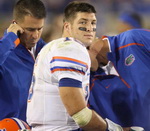 Longtime readers of this blog may know that I am a fan of college football. Several years back, I harbored quite a soft spot for Tim Tebow, since he is a Florida boy attending my alma mater and is about the same age as my son. So I’ve always felt sort of motherly toward him, and the weekend he first returned to the field after a concussion, I was extremely worried about him on every play. Eventually that worry faded and we got back to football as usual, but I’m wondering if now I’ll fall into a similar pattern of worrying about Daredevil every time he gets into hand-to-hand combat with an opponent who could potentially give him a concussion.
As this story develops, my feelings, opinions and concerns will no doubt also transform. And that’s a good thing! Nothing worse than a stagnant, predictable fiction. Lately, things are getting topsy-turvy in this Marvel Universe, but rather than succumbing to seasickness on the Odyssey ocean liner, I’m bound and determined to find my sea legs, hold on to the starboard railing and find out where this boat is taking us.
ROMITA RUMINATIONS
One more thing before I go: Johnny Romita. I saw him previously as the inker for Avengers #23 (check out this month’s Meanwhile post), but this is the first time he’s listed as “illustrator.” I’ve heard for a long time that Romita’s art will be really good, and mostly I like what I’m seeing. However, I was told he draws women exceptionally well, and so far in this issue, with only two quick examples, I’m not that impressed. But I’m willing to keep my mind open. Perhaps in the future I will feel his art has transformed into the masterpieces I have always been told they are.
And speaking of “masterpieces,” I’ll end with a shameless Stan Lee-esque plug for our latest creative project, the Marvelous Zone YouTube channel featuring “Marvelpiece Theatre,” loosely based on the classic “Masterpiece Theatre.” Whew! It took me a long time to get from there to here—but then, it’s taken me a long time to get from where I was 20 years ago, to where I am now: a girl with almost no knowledge of superhero adventures now reading, writing about and making videos based on Marvel Comics! Over time, I too have transformed into something I never expected to be. But sometimes the unexpected transformations are the most satisfying. And looking forward to what comes next—in comics, or in life—is truly the most exciting adventure of all.
| Want to read this comic on your computer? Marvel has a scan! Want to own this story? Buy the Masterworks! |
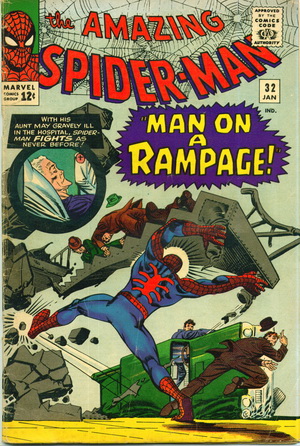
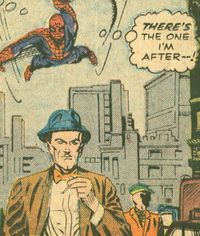 Let’s start with the easiest one: Although Foswell was in fact the gang boss knows as the Big Man (ASM 10), after going legit, he got his job back at the Bugle and posed as “Patch,” who was an informant. The fact that the writers are pulling from so many past stories serves as a reminder of how rich a history they have already established in only 32 issues. Where might they go next?
 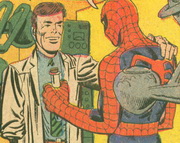 Events being what they are, Spidey also decides to look up his old friend Dr. Connors, who in issue #6 was the villain the Lizard.
 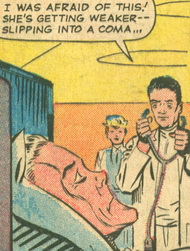 Really? How did that happen? Going back again to issue #10, as Aunt May was having a different medical issue, Peter donated his blood. At first he was reluctant, concerned the radioactivity from his fateful spider bite could be passed on to Aunt May, but he breathed a sigh of relief when the medical professionals informed him his blood was perfectly okay. Well, guess what? They were wrong. And now Aunt May is at death’s door, and once again, as when Uncle Ben died, Peter is involved, and torn up with guilt.
 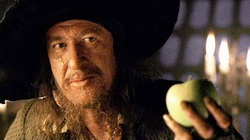 Or…was he?? In the next installment…there he is again, in all his swaggering glory, making a surprise appearance in the very last scene. GASP!! Could it be?? And I do mean “Gasp!” I distinctly remember gasping and grabbing my daughter’s arm when Barbossa appeared. Did anyone else see that coming? Or, twenty years ago, was I not yet as savvy a filmgoer as I am now? Twenty years ago, I had next to nil exposure to the world of comics, so I was probably not aware of a lot of story strategies for these epic types of adventures with larger-than-life characters. I had not yet heard the saying “If you don’t see the body, they’re not dead.” (Russ likes to add, “If you DO see the body, they’re still not dead!”) So the idea of characters coming “back from the dead” was not something I generally considered as a possibility.
 we probably can’t depend upon her being around indefinitely. And unfortunately (and again I’m only guessing), but when Aunt May finally dies, it seems likely Spider-Man will somehow be involved, and poor Peter will once again be racked with guilt.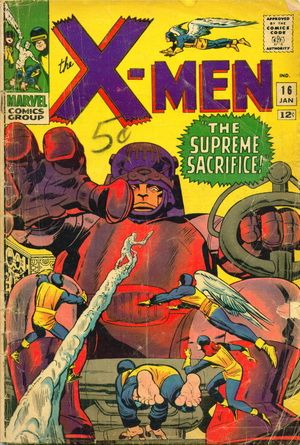
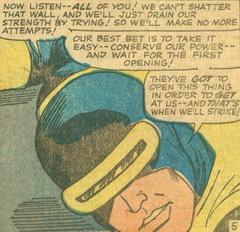 futility of attacking their situation with superpowers, and instead decide on a “Plan B,” which utilizes not only their super-strengths, but also their intelligence and cunning. And as soon as the opportunity presents itself…success! Not to say it’s easy, but the combination of patience, powers, coordination and sheer desperation finally puts them on the other side of the Heavy Grav Globe, fighting and ultimately defeating the Sentinels.
 Of course this hearkens back to Spock’s Star Trek maxim, “The good of the many outweighs the good of the few.” Trask’s emotional insistence on “hope” is good to a point, but in the end, logic must supersede, even at great personal risk. This is bravery, textbook heroism—and it is this final act that transforms Trask from a well-meaning but misguided adversary into a full-fledged hero.
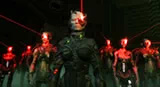 slow moving, individually slow-witted, lacking the capacity for independent thought and creative solutions. Sure, there’s power in numbers, but as in any bureaucracy, numerous nameless minions in an elaborate chain of command does tend to slow things down.
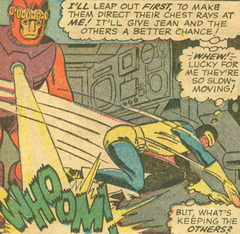 When Marvel Girl turns her powers upon a single Sentinel, she quickly realizes that even a single Sentinel is too much for her telekinetic powers to manipulate. But by using a bit of that good old-fashioned creative problem-solving, she decides instead to focus on only the arms, moving them backwards, which eventually causes the Sentinel to topple over and crash to the ground.
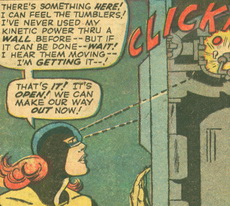 She can’t even see what she’s doing, but somehow gets it done. Necessity is the Mother of Invention? I would add: “Problem…? Solution!”
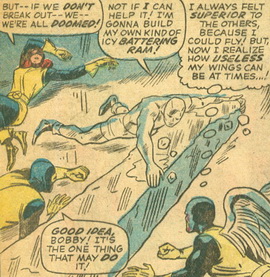 Now, admittedly, any insect that flies is so much scarier than any insect that doesn’t. (Though scampering away at top speed is also disconcerting…) So I can understand why Angel would feel this way about his particular superpower. However, after everything that happens in this issue, I wouldn’t be surprised if Angel now begins to feel differently, to see himself more as an equal to his teammates, rather than above them. (Though, technically, of course, he is often above them…)
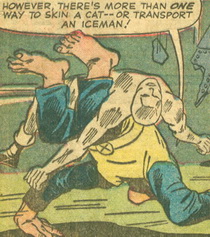 Poor Beast is unconscious for a good deal of this story, but once he gets his wits about him again, he utilizes them in a most advantageous manner, carrying the stricken Iceman across his thighs. “There’s more than one way to skin a cat!” he exclaims. Of all the X-Men, I am least surprised that Beast has employed his creative problem-solving skills to resolve an immediate dilemma.
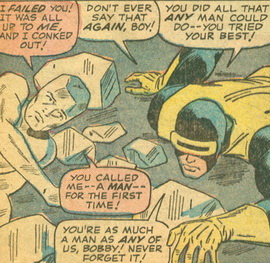 Speaking of Iceman, there’s a lovely moment when he is finally recognized as a “Man” rather than just a boy. His innovative solution to use ice to create pressure to crack the walls of the Heavy Grav Globe ultimately doesn’t work, but it was a good try. When Iceman despairs, “I failed you!” Cyclops prefaces his praise with “Don’t ever say that again, boy!…You’re as much of a man as any of us!” (Ahem? I think Marvel Girl would take exception?)
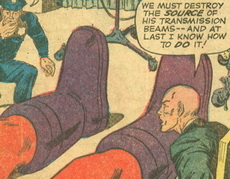 But let’s not stop there! Elaborate problem-solving under intense pressure may still be relatively new for our young X-Men, but Professor X naturally exudes this skill. It’s sort of in his name, Professor X—he’s always thinking. In this issue, the Professor recalls an incident from two issues earlier, when a certain Sentinel was inexplicably incapacitated. Xavier surmises that discovering the answer to this mystery could be their greatest clue on how to take down the whole bunch. Of course, we expect smart and creative thinking from Professor X, but this development also signals a maturing of the level of storytelling, as the events from two issues ago become integral to the resolution of the entire dilemma.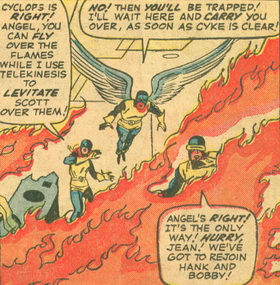
 MEN BEHAVING BADLY
 or is this the inevitable conclusion of a grudge match between two strong macho personalities?
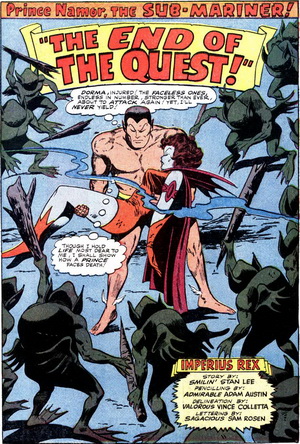 “The End of the Quest!”