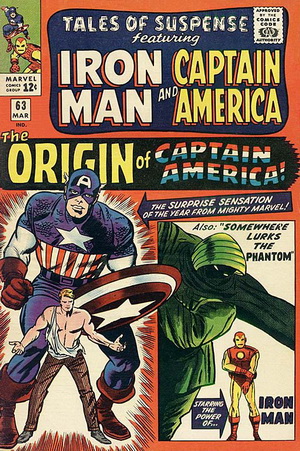
TALES OF SUSPENSE #63: A Child’s Place in the Marvel Universe

Published: March, 1965

Published: March, 1965

“The Origin of Captain America!”
Script: Stan Lee
Pencils: Jack Kirby
Inks: Frank Ray
Letters: Art Simek

This is probably going to read like one of those “Compare and Contrast” essays your teachers always asked you to write in high school. Because this month’s installment of Captain America brings us all the way back to World War II days for a re-telling of his origin story. This story originally appeared in March 1941, and is now recapped (pun intended) 14 years later in the March 1965 issue of Tales of Suspense #63. How could I possibly resist the urge to compare and contrast?

Upon reading the March 1965 account, one serious matter jumped out at me which I found particularly disturbing, so I went back to the original 1941 tale for additional information. Maybe I’m being too critical of what is, after all, a simple form of entertainment, but I can’t shake any of this out of my mind. So instead, I’ll share it.

INTRODUCING BUCKY BARNES
First, in both versions of this story, we learn that when Bucky’s father died in training, Fort Leigh adopted him as camp mascot. To which I say…WHAT?? Really? A human child in a role usually reserved for animals?

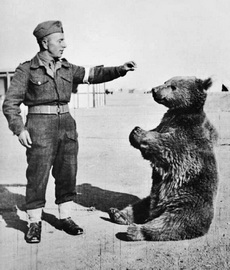
I love this story about Polish troops during World War II that adopted a cigarette-smoking, beer-drinking bear cub as their mascot, but during my online research could not find anything regarding human children fulfilling the same role (excluding, of course, the cigarette-smoking and beer-drinking, though…who knows?) human mascots? Was that really a “thing” that happened back then? Or did it only happen in the Marvel Universe?
Several questions immediately arise: How long ago did Bucky’s father die? How old was Bucky at the time? And where is his mother? Under what circumstances was this boy completely orphaned with nowhere else to go (no grandparents? Aunts? Uncles?) and no other viable options, other than to become the camp mascot at a military installation?

And furthermore, where was Child Protective Services? Or was that not a “thing” back in 1941? In the 1940’s, if children were irretrievably orphaned, did the government step in and assign them to an orphanage, or was their fate simply left up to the kindness of strangers?

Or maybe Bucky’s new role as camp mascot was the result of the government stepping in. But if so…who exactly is his guardian? Who is making decisions regarding his welfare? I would think it would be the commander of the base.

One thing I know for sure, it is not Private Steve Rogers. And yet, when Bucky bursts into Steve’s tent and finds him slipping into his Captain America uniform, after an understandably awkward moment, a partnership is formed.

There are so many things wrong with this scene.

READY OR NOT…
First, I can’t get over the fact that Rogers’ immediate reaction upon being discovered is to say he was careless and “I should have faced the tent entrance.” How would that have changed anything? What he actually needed was a lock, or at least a screen to change behind. No, I take that back, what he really needed was a readily available plausible alibi for anyone who might have walked in. “Oh! I’m…uh…going to a costume party!” Or “My dear old grandmother suffers under the delusion that because I’m in the Army, I must be Captain America, and she just mailed me a new suit to wear when my other suit is in the laundry.” Living in an environment of tent flaps and no locks, why not prepare for the inevitable? Or is he so addicted to TRUTH, justice and the American way that he can’t tell even a little fib, even to a pesky teenager?

WHOSE IDEA IS THIS, ANYWAY??
Sigh…I just had to get that out of the way. But now we come to the first major discrepancy between the two accounts of this fateful event. In 1941, when Bucky discovers Steve Rogers’ secret identity, it is Rogers himself who immediately declares, “From now on we must both share this secret together…that means you’re my partner, Bucky!” In 1965, Bucky comes up with the idea, but Rogers readily (or reluctantly? It’s hard to tell…) agrees, “Looks like I’ve got no choice.”

It’s more than a subtle difference, and I give the 1965 writers credit for making the change. Because in no universe ever is it appropriate for an adult to enlist a child in a series of dangerous activities. Granted, it’s still not cool that that Rogers succumbs to young Bucky’s insistent demands with “Looks like I’ve got no choice.” This gives the impression not only that Rogers considers the secrecy of his alter ego more important than the welfare of a minor, but also that he and Bucky have now entered into a sort of blackmail scenario. But it somewhat takes the edge off Private Steve Rogers’ complete lack of social responsibility; in any universe, at any time, he should know better.
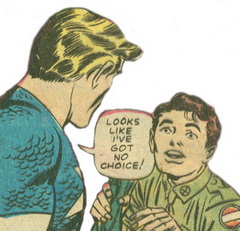
My 21st century sensibilities have now been stretched to the limit.

Furthermore, it seems no Army brass is involved in this decision, which would be highly unlikely, especially for straight arrow Captain America, who always does things “by the book.” Of course, he’s now forced into a situation where his secret identity has been uncovered, and in the Marvel comic book world of (most) superheroes, maintaining secret identity is paramount to all else. But again, the time to plan for that possibility is BEFORE you change into your superhero costume in a TENT with no planned ALIBI. And if you fail to plan, and risk exposure as a superhero, the solution, above all else, should not be putting a child at risk.

AND EVERYONE IS OKAY WITH THIS…?
Later in the story, we see Cap and Bucky fighting crime and Nazis, and newspaper headlines are boldly celebrating their victories. Once the public became aware of Cap’s teenage sidekick, wasn’t there a public outcry against reckless endangerment of a minor?

Okay, I think I actually know the answer to that question. Once again, I’m applying my 21st century real world sensibilities to an early 20th century comic book world. In the comic-book world, apparently superheroes have adolescent sidekicks all the time, and no one ever bats an eye. Over at DC, every Superman had a Superboy, every Aquaman an Aquaboy, every Batman his Robin. It was a “thing” that happened with alarming regularity. So why not Bucky? There’s no particular reason to deny Cap his little partner—except that pesky issue of why Bucky was “camp mascot” in the first place.

Maybe I should just get with the program and get over it. You think?

ENTER RICK JONES
But then there’s this: Twenty-something years later, when Bucky is long dead and gone, Rick Jones appears in the Marvel Universe as a very similar character. He is also an orphan, apparently about the same age, and though he is not a “mascot” of any kind, he does like to hang out around military installations and superheroes.
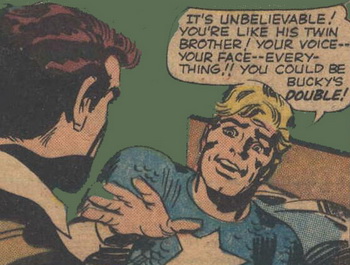
There’s this whole thing that goes on with young Jones and Bruce Banner, but Rick also becomes a “sidekick” of sorts to the newly-resurrected Captain America. In Avengers #4, when Cap first sees Rick Jones, we learn that Rick is (inexplicably) like Bucky’s twin brother. And again, I’m scratching my head. Why? Why does he have to be just like Bucky in every way? Face, voice, the whole nine yards. I understand we’re in a comic book world, but that doesn’t mean we need to abuse the reader’s suspension of disbelief at every turn.

But anyway, a camaraderie builds between the two, and in Avengers #5, we learn that Cap has undertaken Rick’s physical training, much as he did with Bucky. In Avengers #6, Rick tentatively begins to propose to Cap that he might take Bucky’s place, but Cap digresses into a guilt-filled proclamation of revenge for the death of his former partner. When Rick further pursues his campaign in Avengers #7 by donning Bucky’s old outfit, Cap completely flips out, insisting “I’ll never have another partner! I won’t be responsible for another life—never!!”

Yet, despite this bold declaration, non-superpowered and barely-trained Rick Jones continues to accompany the Avengers on numerous dangerous missions. Why? He brings nothing to the fight, and is only likely to get in the way and slow down the action, much like a Baby Groot.

At this time, Rick is also attending Avengers meetings—though, reasonably enough, he is not allowed a vote. And when Iron Man, in Avengers #10, suggests making Rick Jones’ membership in the Avengers official (“as the Wasp’s is”…don’t get me started), he refers to Rick as “Cap’s young sidekick.” Which he obviously is, even though Cap still refuses to own it.

I’ve reluctantly come to understand that I shouldn’t have real-life expectations of a comic book world, but it is within my rights to expect some level of consistency within the comic book world. In neither 1941 nor the mid-1960’s does it make any sense that someone of Captain America’s high upstanding moral character would allow a non-superpowered child to be endangered by fighting super-villains. And it especially doesn’t make sense that Cap would be fine with allowing Rick Jones to come out on Avengers’ missions, but not want to allow him all the rights and privileges that come with official admittance to The Avengers. It simply doesn’t seem fair. And if there’s one thing I would expect from Captain America, it’s that he should be FAIR.

THE STYLIN’ 1940S
But enough of that. One more thing before I go. I mentioned earlier that reading this 1965 version of the Captain America origin story compelled me to go back to the original—which, by the way, due to Russ’ extensive collection of Marvel Masterworks was no further away than my nearest bookcase.

First, on the plus side I noticed that most of the details of the story were spot-on. One of my pet peeves is a movie that is “based on a true story,” but you find out later that it is actually only very loosely based on that true story, and maybe, in real life the hero died, but in the movie, he lives. And becomes President. Why would I waste my time with garbage like that? If it’s true, remain true, if not, label it as fiction. I was happy to see that the later telling of Cap’s story was faithful to the original.

Next, I absolutely loved the collage of newspaper headlines that serves as a backdrop in both the 1940’s and 1960’s versions of the story. We can all readily remember numerous movies with spinning newspaper headlines that cover a lot of story ground in a very short time. Having a similar, almost cinematic device in these comics across so many decades warmed my soul.
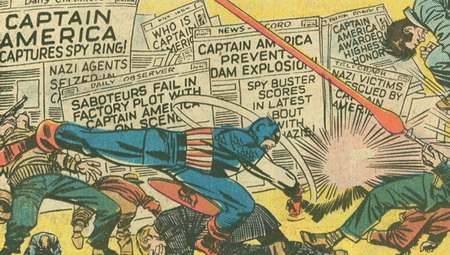
However, I was not pleased to find that the original story had an extra layer of ooomph that has apparently been abandoned by the 1960’s. Looking at the 1941 comic, I was most impressed by the creative page layouts, and the way certain elements would “bleed” out of the frame. This gave the comic a vibrant, kinetic energy I haven’t seen with any regularity in the 1960’s comics I’m currently reading. Take a look:

And now compare this to the visually busier, yet somewhat less exciting 1965 version:
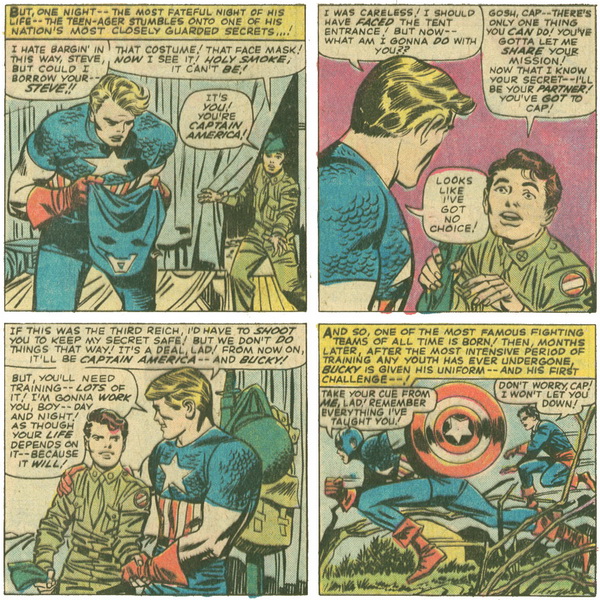
Sadly, I find myself wondering why the difference of 24 years has led to such a lack of pizazz. Did someone somewhere along the way make a deliberate determination to color only within the lines? Was it, perhaps, decided that it was too “hokey”? If so…Hello! It’s a comic book! Hokey is just fine. But if it’s not for any of these reasons, the only other explanation I can come up with is that the creators have just become lazy. Which is not encouraging.

Also not encouraging, at the end of the March 1965 retelling of Cap’s origin story, the narrator announces future issues will feature further tales of Captain America and Bucky in WWII. Will these be re-runs of stories that appeared in the 1940’s comics? Or new stories? Why was this decision made? And what does this say about this title not being able to come up with new ideas?

Full disclosure: this Captain America title on the back end of Tales of Suspense has never been one of my favorite planets in the Marvel Universe. It’s pretty much “Cap meets bad guys and fights them and wins,” which is dreadfully dull for anyone who is not an eight year old boy…in 1941. At this point, I’m dreading the upcoming Cap and Bucky in WWII stories I’ve been gleefully promised are on the way. Where is my beloved soap opera? My only hope is that a girl might work her way into it. And if that girl happens to be Peggy Carter, I would be perfectly okay with that. But even better, I’d love to see some stories where Captain America gets involved in a “boy meets girl, boy hates girl, boy loves girl” plotline with…Bucky’s social worker!

Am I asking for too much?


Now, let’s turn our attention to the first story is this issue…
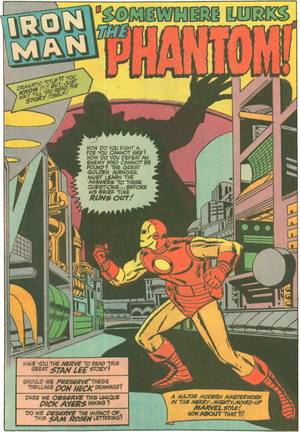
“Somewhere Lurks the Phantom!”
Script: Stan Lee
Pencils: Don Heck
Inks: Dick Ayers
Letters: Sam Rosen

IN A NUTSHELL
Tony develops a new transistor, allowing him to breathe fully, without his armor. Now free to return to his civilian identity, he explains to Happy & Pepper that he’s been incommunicado at sea, where he has gotten engaged. Later, the mysterious Phantom engages in a sabotage spree at Stark Industries, and when the union threatens to strike over safety concerns, Iron Man captures the Phantom and reveals his identity: Dr. Birch, un underappreciated scientist on Stark’s payroll.

WHAT’S HOT
I’M ALIVE!! Stark finally figures out how to get out of his armor so he can again appear as Tony Stark. Good! That storyline was getting stale, and besides, we need to see Stark’s handsome face again. The best part of the whole “Tony Stark is missing/dead” scenario is that it made me realize that the best part of Iron Man is Tony Stark…and vice-versa.

SPIDEY SENSE? Iron Man has a sort of “Spidey Sense,” but of course it’s technological, not organic. His “built-in radar-type detector,” gets the job done…and, added bonus, it also “tingles!”

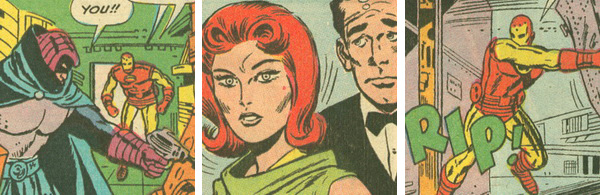
ECONOMY ANNOUNCEMENT. I love a good character “announcement,” and the one at the bottom of page nine is perfect! When Iron Man finally confronts the Phantom, about to squeeze a trigger of massive destruction, there is no time for drawn-out introductions. The Phantom simply exclaims, “YOU!!” Classic.

NO LOVE LOST. Stark employees are no Iron Man fans, and not afraid to let their feelings be known. One refers to him as a “shell-headed creep,” and Happy calls him a “walkin’ junk pile”…to his face! This crew has sworn an oath of loyalty to Mr. Stark, not to Iron Man!

WHAT’S NOT
A LOVE MAGAZINE. The soap opera in this tale was so overwhelming that at one point the narrator quips that the reader may think they bought a “love magazine” by mistake. I love soap opera probably more than the average Marvel comics reader, but this issue was laying it on pretty thick. Even for me!

CORNY GET-UP. When Iron Man finally sees the Phantom, he wonders “But why the corny get-up?” As he peers through the metal eye slits of his yellow and red helmet held together by rivets, lamenting the heaviness of his clanking boots.

MISS MARPLE IS BORED. The villain is hapless, bitter, ignored Stark Industries employee Dr. Birch. Too easy. I was hoping for at least a bit of a challenge. Maybe the blustering Union Rep? The angry congressman? How about Spider-Man, who’s pissed off at Iron Man for stealing his tingly Spidey-Sense?

SO…WHO’S THE LUCKY GIRL? Stark comes up with a viable explanation for his absence, but he digs himself into a bigger hole. For “I’m engaged to a Boston debutante” to work, he has to produce a girl who is both a debutante, and from Boston. Of course, any Boston debutante in her right mind would marry Tony Stark in a heartbeat, if he just asks her. Stay tuned…?
Want to read this comic on your computer? Marvel has a scan!
Want to own the Iron Man story? Buy the Masterworks!
Want to own the Captain America story? Buy the Masterworks!
Posted in Captain America, Iron Man, Tales of Suspense | 4 Comments

Meanwhile…: February, 1965

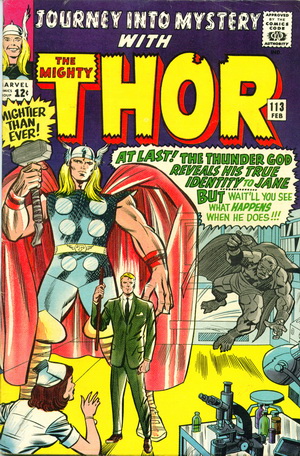
JOURNEY INTO MYSTERY #113

“A World Gone Mad!”
Script: Stan Lee
Pencils: Jack Kirby
Inks: Chic Stone
Letters: Artie Simek

IN A NUTSHELL
Thor renounces his immortality and, as Don Blake, reveals his true identity to Jane. Enraged, Odin removes Thor’s powers, so when Don attempts to prove to Jane that he’s Thor, he fails, leading Jane to believe he’s delirious. At that moment, Grey Gargoyle attacks, seeking Thor. He chases Don through the streets, but he turns back into Thor with the aid of Honir, sent by Odin to ensure Thor’s survival. After defeating the Gargoyle, Don realizes he can’t give up being Thor, so he returns to Jane and assures her that the madness has left him.

WHAT’S HOT
PERHAPS TODAY I WILL LEARN A NEW WORD. And perhaps that word will be “mayhap.” I say again, Marvel Comics is a great place for increasing your vocabulary.

FORMALITIES. As Thor decides he will indeed forsake his Asgardian heritage in order to be with the woman he loves, he sets off to find his beloved…whom he refers to as “Jane Foster.” When Blake and Jane see each other again, she calls him “Dr. Blake.” These people have a lot to learn about how romance works. But a few panels later, they let their hair down and are “Don” and “My darling.” And I feel better about this relationship.

FLYING CHICKEN. Okay, this just struck me as funny. When Odin is out of sorts, he casts out his royal chef, throwing all manner of food after him, including a chicken, which appears to be flying. The temper of Odin paired with a flying chicken is what comedy is made of.

SPLIT SCREEN. In this story, we toggle back and forth between Earth and Asgard, making the whole business jam-packed and fast-paced. Do try to keep up!

LOOPHOLE. When Thor’s friends hear of his predicament on Earth, they wisely decide to act quickly, before Odin can instruct them not to. They’re not waiting, and they’re not asking permission. These are true friends.

SNAZZY CAR. As Blake and Jane flee the monstrous Gargoyle, at one point they take flight in Blake’s very snazzy, very sexy red convertible. For a dull doctor, he sure has got the automotive going on!

WHAT’S NOT
STONE WINGS. I just said Blake and Jane “take flight” in a snazzy car, and that’s cool. But when the Gargoyle notes that his stone wings give him the ability to flight, I’m thinking…not cool! Not buying it! In what universe does stone make you lighter than air? Science, please!

30 SECOND RULE. Honir touches Blake’s hand, imparting a magical 30 seconds for Blake to transform to Thor and conquer the Gargoyle. First of all, 30 seconds is not nearly enough time to do that, and the absurdity of it is furthered by the two Asgardians engaging in so much jibber-jabber, wasting precious seconds. Halfway through, Thor notes that he now has only 15 seconds left, and undertakes a series of actions that would clearly need at least five minutes. Why impose the artificial and ridiculous limit of thirty seconds, and then go on to nullify it by page upon page of time-eating story? The suspense is blown to bits by the reader’s incredulity.

LEAVE IT TO THE COPS. At the end, when Gargoyle is melted into an inanimate object, Jane wonders what will happen should he ever break free. Blake’s answer: “The police will handle it.” LMFAO! Really? When Gargoyle first appeared, Blake tells Jane to get a policeman…to summon the Avengers! But before they can arrive, it takes everything Thor has to conquer the Gargoyle on his own. Yet now, somehow, we’re supposed to believe “the police will take care of it.” Unless, by this, Blake is simply saying, “The police will call the Avengers.” Yeah. I think that works better.

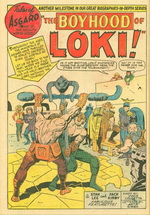
“The Boyhood of Loki!”
Script: Stan Lee
Pencils: Jack Kirby
Inks: Vince Colletta
Letters: Artie Simek

IN A NUTSHELL
Young Thor and Loki watch a jousting battle, and they enter into a wager on the victor. Thor’s champion is about to win, when Loki casts a spell to help his favorite. The Asgardian warriors are quick to realize skullduggery, and they capture both boys. They accuse Loki of the spell, because they doubt that Thor would ever engage in trickery. Thor insists that they both be punished equally, and overwhelmed by his gallantry, they decide not to punish either youth. Overcome with jealousy over the unequal treatment, Loki vows to work harder than ever to destroy Thor.

WHAT’S HOT
HOT ART. I really enjoyed the artistic depictions of Loki in this tale, who believably looks like a downright miserable child. (pic 3.4)

WHAT’S NOT
NOT. This was a totally unnecessary story. We learned nothing we didn’t already know. Except that as children, Thor and Loki were forced to wear tunics displaying their first initial, a la Laverne and Shirley, in case they ever forget who they are, or get their clothes confused with that of the other little young gods in Asgardian kindergarten.
SAY WHAT??? Ultimately, this story raises more questions than it answers, because it once again thrusts into the spotlight that the “gods” of Asgard are born, go through childhood, and eventually age (as we see in Odin). What sort of “gods” are these? I’m not sure I understand. And they are called “Immortal” (as you’ll remember from the previous story, the Gargoyle was after the secret of Thor’s immortality), yet I believe it is possible for them to die. So…not actually immortal? So many questions, I can’t tackle it all here, but look forward to a deeper exploration of these conundrums in a future post.

Want to read this comic on your computer? Marvel has a scan!
Want to own the story? Buy the Masterworks!

TALES OF SUSPENSE #62

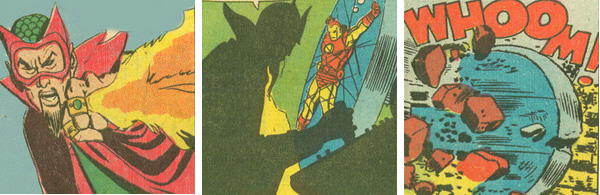
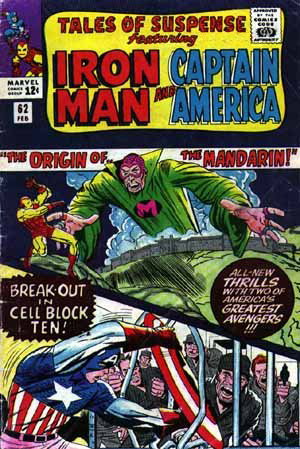
“The Origin of the Mandarin!”
Script: Stan Lee
Pencils: Don Heck
Inks: Dick Ayers
Letters: Sam Rosen

IN A NUTSHELL
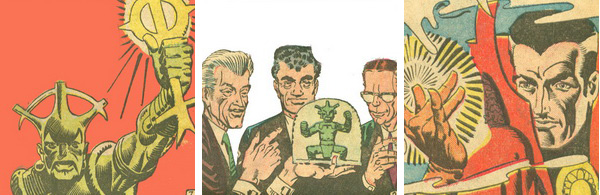
The Mandarin relates his origin to the captured Iron Man. Born into nobility, Mandarin lost both parents while an infant. After he reached adulthood, China’s regime confiscated his property. One day, his wanderings led him to an alien spaceship. Inside, he discovered ten rings that granted him immense powers, and with them, he subjugated the outskirts of China. Finishing his tale, Mandarin engages his death trap on Iron Man, but Iron Man escapes and intercepts a rocket. The Mandarin eludes Iron Man, and Iron Man returns home.

WHAT’S HOT
WELL, THAT CERTAINLY EXPLAINS A LOT. Mandarin’s backstory is tailor-made for a super-villain, complete with tragedy and a totally dysfunctional upbringing.

SURPRISE SURPRISE SURPRISE! Extraterrestrial influence is the last element I would have every imagined in the Mandarin’s backstory.

COMEDY TONIGHT. At the bottom of page eight, Iron Man stops in the middle of a world crisis to make a few self-deprecating jokes. (“I’m beginning to sound like some corny mad scientist in a Grad B movie!”) Which naturally leads to my next point…

SPIDEY, IS THAT YOU? During the fight scene with Mandarin, Iron Man is so chatty, I have to wonder if Stan was up late and getting confused and thought he was writing for Amazing Spider-Man.

BAKOOOO! I am a big fan of the onomatopoeic sound effects in Marvel Comics, and here is a new one, in case you were wondering what sound a firing tank gun might make, it’s “BAKOOOO!”

WHAT’S NOT
“KEEP HIM TALKING.” When Mandarin cannot resist the super-villain proclivity for needling his captured prey with a self-serving oration of “How I Did It,” Iron Man wisely deduces this will give him extra time to find a way out of his predicament. Will these super-villains never lean??

SORRY, I GOTTA RUN…Mandarin sets his elaborate death traps, but leaves Iron Man BEFORE he is actually dead. Like any good super-villain, he assumes his diabolical plan will succeed and feels no particular need to stick around and be certain. Clearly Mandarin is not a fan of James Bond movies.

TESTING, 123, TESTING? Mandarin sells a missile to China, but the Chinese don’t know that he has set the missile to reach Formosa (Taiwan). And it appears the Chinese decide to shoot it off without first programming in any particular coordinates! Now, it’s possible the Chinese did indeed enter their own coordinates, and Mandarin’s coordinates overrode those, but…nowhere in the story are we told that!! We’re left believing that the Chinese just fire off missiles willy-nilly with no particular concern for where they might land. Jeez…

DID I SAY THAT PART OUT LOUD? Why in the world does the Mandarin TELL Iron Man that his disintegrator ring takes 20 minutes to recharge? Does that particular strategy of revealing your weaknesses to your opponent really work for you, Mandarin?


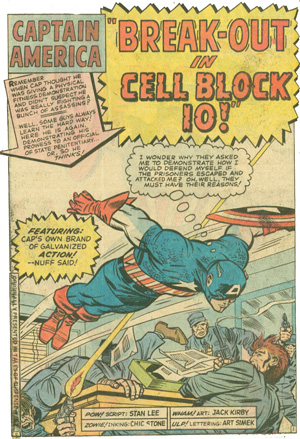
“Break-Out in Cell Block 10!”
Script: Stan Lee
Pencils: Jack Kirby
Inks: Chic Stone
Letters: Art Simek

IN A NUTSHELL
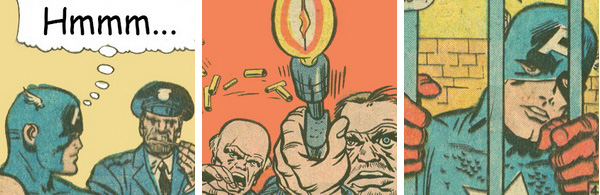
Cap engages in an exhibition at a prison of how he would battle escaped convicts. Afterwards, the prison guards surround him in the cell block and reveal that they are, in fact, convicts, and they need Cap’s shield to help them open the final gate to the prison. They throw Cap in a prison cell, and unsuccessfully attempt to open the gate. Cap escapes his cell and defeats all the convicts. Later, the freed prison warden reveals that the only way to open the gate is to speak the words “Captain America.”

WHAT’S HOT
TRICKED! Nice twist right at the start there (when there was hardly anything there to be twisted at all) when it turns out it’s the prisoners impersonating prison officials. Cap may have many super powers, including Observation. (“I know that this job requires really RUGGED guards…but THESE fellas somehow look too…BRUTAL!”) However, Intuition is obviously not one of them.

THANKS BUT NO THANKS. Cap threw away the “magnetic gimmicks” Iron Man installed on his Shield because they ruined its “delicate balance.” Obviously, Cap’s the kind of guy who would rather drive stick shift. And he really doesn’t relish those newfangled push button telephones either!

CURSES! FOILED AGAIN! Cap escapes the jail cell by wedging a folded chewing gum wrapper between the lock and the door. How’s that for good ol’ (Captain) American ingenuity?

WHAT’S NOT
OPEN SESAME. At the end of the story, the warden reveals that the iron door only opens to the phrase “Captain America!” How adorable. Only, it’s not true, or it’s not working, because at least TWICE during the melee, someone clearly says “Captain America” while standing in front of the door! And even if this clever password was working, it’s not really that clever—is it?—in a jail setting, where superheroes are likely to be a frequent topic of conversation. (I suggest, instead, the name of the Warden’s family dog.)

NO WAY OUT. Wait. If the big iron gate is the only way out, how did Cap get in? Perhaps he fell in, through a giant plot hole?

BORED NOW…In the middle of one of the fight scenes, Cap says, “Look boys, I’m getting BORED with all this activity.” Sigh…So am I. Next story, please!

Want to read this comic on your computer? Marvel has a scan!
Want to own the Iron Man story? Buy the Masterworks!
Want to own the Captain America story? Buy the Masterworks!

STRANGE TALES #129

“The Terrible Trio!”
Script: Stan Lee
Pencils: Dick Ayers
Inks: Frankie Ray
Letters: Art Simek

IN A NUTSHELL
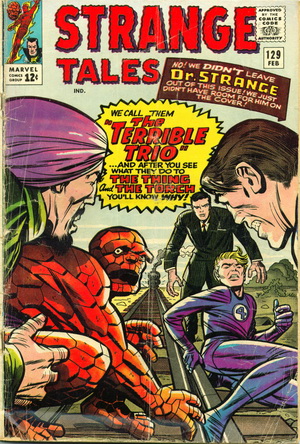
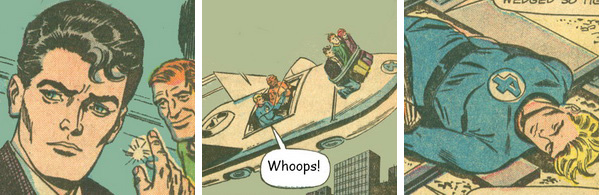
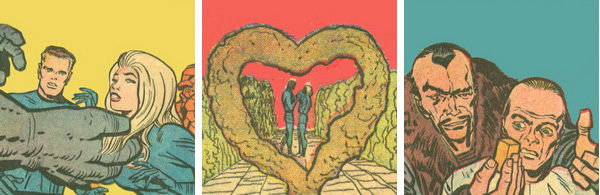
Johnny has to cancel his date with Dorrie when the Terrible Trio escape from prison. He searches for the convicts, but when his flame gives out, they capture him. Johnny escapes, but during the melee that follows, he gets stuck in the railroad tracks. He sends off a flare to alert Thing, but when Thing arrives to rescue the collapsed Torch, the Trio swoops in. Thing fends off an oncoming train, then captures the villains. Johnny reawakens, and Ben basks in recounting his victory.

WHAT’S HOT
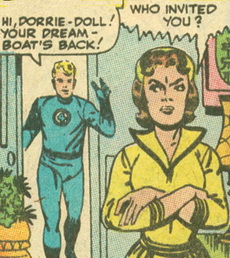
CONTINUITY. In my recent feature on this month’s Amazing Spider-Man, I wrote at length about Doris Evans, expressing the same dismay Doris is now hurling directly at Johnny: “I don’t know what on earth I see in you!” A reference is even made to the “gentlemanly” Peter Parker whom Doris met in Amazing Spider-Man #21. What fabulous continuity! And by the way, it doesn’t make me change my mind about Doris at all.

COLLABORATION. In Doris’ defense, however, under the artistic direction of penciller Dick Ayers and inker Frankie Ray, she’s looking better than she ever has before. In addition, Handsome Harry actually looks handsome—as does Bull! So, with such good collaboration going on between Ayers and Ray, why, at the end of this issue, are we promised a new artist next time? If it ain’t broke, don’t fix it!

CHALLENGE CHALLENGED. It takes THREE villains of this caliber to face only one member of the Fantastic Four. It may be true that in this story the Trio faces both Torch and Thing, but not at the same time. Thing is absent at first, and Torch is knocked out later, so it’s really three-against-one in each case…and even then, the Terrible Trio can’t get the job done! As super-villains go, not actually so “terrible.”

WHAT’S NOT
DAMSEL IN DISTRESS? Being unconscious and bound to a train track is not a good look for a superhero. On the splash, Stan seems to recognize that the readers may not be on board with this Perils of Pauline rip-off and tries to disassociate himself with it before the story gets started.

HELLO, I CAN HEAR YOU! Handsome Harry has the weakest superpower ever: super-hearing! Of course, that’s only the weakest if you don’t count his being incredibly handsome as one of his “superpowers.” Either way, I maintain that my superpower of correctly being able to guess the correct size container for leftovers far exceeds anything Handsome Harry can bring to the table! (Hey! I’ll take on Sue Storm serving up a Thanksgiving dinner any day of the week!)

STUCK ON YOU. How is it that the Trio doesn’t fall off the precariously tilted Fantasticar? Are we witnessing one of their previously undisclosed superpowers? Or did Torch and Thing inexplicably get an assist from Paste Pot Pete?


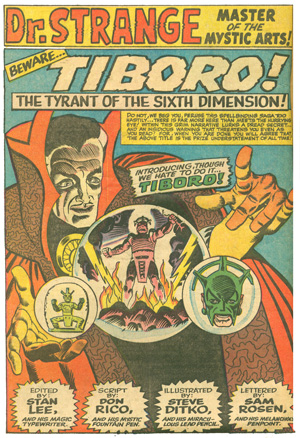
“Beware Tiboro!”
Script: Don Rico
Art: Steve Ditko
Letters: Sam Rosen

IN A NUTSHELL
The scientists of the tv show The Twelfth Hour hold a Peruvian idol up to ridicule, but when the lights go out, then come back on, the hosts have disappeared. Alerted to the supernatural events, Strange arrives and deduces that they’ve been captured by Tiboro. Strange teleports to the sixth dimension, and battles Tiboro. Tiboro eventually admits defeat, but vows to return if earth’s civilization decays further. The rescued scientists offer to devote future episodes to Strange, but he casts a spell of forgetfulness over them.

WHAT’S HOT
NO EGO. I’m so impressed by how much of an ego Dr. Strange doesn’t have. Challenged by the scientists to defend the mystical arts, he quietly declines because he fervently believes the public is not ready. Later, after the scientists ridicule him on TV, Strange is called in to rescue them, and does so with expediency. When the scientists become believers in the mystic arts, they want to broadcast their newfound knowledge to the world—but Strange, true to his convictions, wipes their memories clean to prevent that from happening. For Strange, it’s not about him, it’s simply about doing what is RIGHT. Hey! I have an idea! Dr. Strange for President??

ZOOM. When Strange is stumped by the icon, he conducts a supernatural Zoom meeting with the Ancient One to glean more information. LOL, way too topical these days!

WHAT’S NOT
FAIR FIGHT? In the interest of “fair play,” Strange takes off his cloak after he supernaturally convinces Tiboro to put down his wand? But can fair play ever really be anticipated when tangling with a super-villain? Especially one who describes himself as “the spirit of decay”? It always frustrates me when the Hero’s Code goes too far.

CONSEQUENCES? And continuing my previous thought, when all is said and done, Strange simply lets Tiboro GO FREE with a stern warning to never do that again. Yeah, right, like that’s gonna happen…

Want to read this comic on your computer? Marvel has a scan!
Want to own the Human Torch story? Buy the Masterworks!
Want to own the Doctor Strange story? Buy the Masterworks!

FANTASTIC FOUR #35

“Calamity on the Campus!”
Script: Stan Lee
Pencils: Jack Kirby
Inks: Chic Stone
Letters: Artie Simek

IN A NUTSHELL
While touring State U, the FF encounter Professor Gilbert, who is attempting to construct a super-powered being. Later, while Reed gives a lecture, Thing discovers that Diablo has returned, and has used a potion to instill life in Gilbert’s creation, whom he has christened Dragon Man. Diablo orders Dragon Man to protect him, and battle ensues. Sue ends the fight when she learns that Dragon Man responds to kindness. When Diablo attacks, Dragon Man saves them, and both Diablo & Dragon Man apparently drown in a frozen lake.

WHAT’S HOT
BE OUR GUEST! As the story at State U is beginning to settle in, we are treated to a guest appearance not only by Professor Xavier and Scott Summers, but also Peter Parker, who is scoping out his post-high school prospects. Extra points for the continuity of Johnny remembering Peter as “the guy Dorrie tried to get friendly with till I put the kibosh oh him!”

FILL IN THE BLANK. As the FF prepares to leave campus, someone mentions that they haven’t had this much excitement since they invited Jayne Mansfield to lecture on philosophy. Hmmm…wonder how that one turned out?

CLIFFHANGER. At the very end, we get a hint that Reed and Sue are perhaps soon to be engaged! Good news! Except…we’ve been here before, haven’t we? So I’ll hold off checking out their gift registry, at least until I see what happens in the next ish.

WHAT’S NOT
“SO! WE MEET AGAIN!” Yes, Diablo actually says this when he first sees Thing. He also tells poor little Dr. Gilbert, “I will show you wonders beyond your wildest dreams!” (Which naturally conjured up memories of Pedro in Napoleon Dynamite) Where does Diablo get these gems? From his pocket edition of “The Super-Villain’s Guide to Hackneyed Retorts”? They must have been listed right after, “MMMWaahHaaHaaHaaHaa!!!”

BEAUTY AND THE BEAST? Shortly after Sue defers to her “woman’s intuition” (mentioned so often, one has to wonder if Stan actually counts it among the list of Sue’s “superpowers”), she decides to try a little tenderness with the monster…and it almost works! Ultimately, I was disappointed that the day wasn’t won by Sue lulling the Dragon Man to sleep with a gentle lullaby.

GET TO THE POINT. On the very busy splash, Stan tells us they can’t waste any more time on introductions since “we’ve got a lot of story to tell!” This is immediately followed by five or six pages of mostly nonsense, including Reed and Thing playing football, signing autographs, superhero cameos, and a running joke about high school Johnny pouting because the college co-eds aren’t interested in him. Now, don’t get me wrong, I love all that color, but please don’t preface it by saying “we’ve got a lot of story to tell!”

Want to read this comic on your computer? Marvel has a scan!
Want to own the story? Buy the Masterworks!

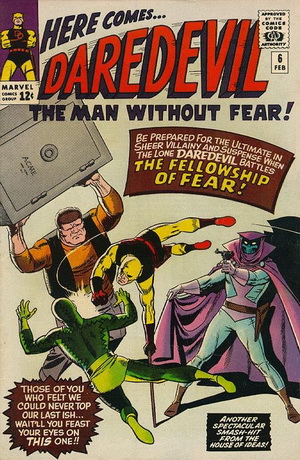
DAREDEVIL #6

“Trapped by the Fellowship of Fear!”
Script: Stan Lee
Art: Wally Wood
Letters: Sam Rosen

IN A NUTSHELL
Aided by henchmen Ox and the Eel, new villain Mr. Fear shoots Daredevil with a fear pellet, causing DD to panic and run away. The next night Daredevil tracks down the villains and battles them, but in the course of the fight, Foggy is injured. Later, while Karen watches over Foggy in the hospital, Daredevil waits outside. When the villains arrive to kill Foggy, Daredevil attacks, chasing them back to the museum. Daredevil uses a fan to blow the fear gas away, and defeats the villains. Back at the hospital, Foggy recovers, while Karen scolds Matt for not looking after his partner.

WHAT’S HOT
WELCOME TO THE FUTURE! Murdock has a tiny television on his office desk. For 1965, that is either very high tech, or very high class!

IS THAT AN ARRHYTHMIA IN YOUR CHEST OR ARE YOU JUST GLAD TO SEE ME? Murdock is such a romantic (or such a chauvinist?) that the only reason he can find for the quickening of a woman’s pulse is that she is near someone she loves. It never occurs to him that she may have just been running to catch a bus, or had one too many cups of coffee that morning. But then, with all his superpowers, he would probably smell sweat or coffee, and from there, deduce correctly. But in the absence of sweat or coffee, it can only mean one thing: love! (I wonder what he deduces when a man’s pulse rate is high and he hasn’t been running or drinking coffee, or trying to stave off turning into the Incredible Hulk?)

PSA. Foggy’s doctor makes a point of saying that he has a very good chance of survival, since there is “no excessive trace of alcohol or tobacco in his blood.” Obviously, Foggy’s policy is to JUST SAY NO. Still, I’m confused by the word “excessive.” Are the Marvel writers advising their young readers that a little drinking and smoking is okay?

SLIMY SOUND EFFECTS. When Daredevil finally gets his chance to wallop the oily Eel, the sound effects are appropriately askew: Klop! Skak! Wup! Thwip! I’m guessing we won’t see these made-up words again…until the next time someone has to tangle with the slippery Eel!

WHAT’S NOT
MEN COMMUNICATING BADLY. On the middle of page nine, both Foggy and Matt are secretly making plans to return that evening to ferret out the criminals, but they don’t share their plans with each other. Matt obviously cannot tell Foggy he is Daredevil, and Foggy probably feels it would be too dangerous to invite his blind buddy to tag along. So, I know there are actually very good reasons for the two of them not communicating with each other, but the image of their nearly identical thought bubbles right next to each other smacks not only of irony, but also the well-known cliché that men are not master communicators.

WAIT, LET ME GRAB MY PURSE! When Karen hears that Foggy is in the hospital, she rushes right over there, in only ten minutes. I surmise she must live extremely close to Municipal Hospital, because within those ten minutes she had time to completely change her outfit, grab a fancy purse, don high heels, and even put on gloves! Who bothers to put on gloves when rushing to the hospital?

YOU HAD ONE JOB…When the Fellowship of Fear breaks in to kill Foggy, it turns out Mr. Fear has forgotten to bring along his Fear Gun. Without it, he’s not Mr. Fear, he’s just a mad scientist with no test tubes. What good is he?

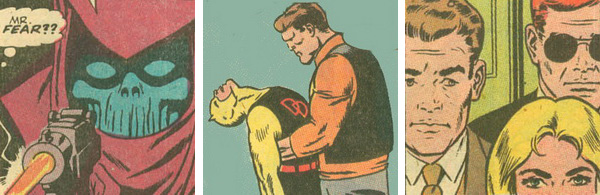
MY NAME IS “FEAR” BUT YOU CAN CALL ME “MR.” Why does Zolton Drago call his costumed alter-ego MR. Fear? Why not Dr. Fear, or Captain Fear, or Commander Fear? Mr. Fear just sounds so…not fearful.

I WONDER
When Daredevil first hears “Mr. Fear,” his thought bubble reads, “Mr. FEAR??” but we don’t see his expression, so there are no clues what he is thinking at that moment. It appears he says it just before Mr. Fear fires the pellet at him, so I’m discounting that he is already under the influence of the fear gas. My guesses are that he’s thinking, “I’ve never heard of this guy! Who could he be?” or “What a stupid name!” or “What a GREAT name! Wish I had thought of that!”

WHERE DO WE GO FROM HERE? So. There is a Fear Potion in the Marvel Universe. What a powerful weapon in the right or wrong hands! Or…are we simply going to forget it exists?

Want to read this comic on your computer? Marvel has a scan!
Want to own this story? Buy the Masterworks!

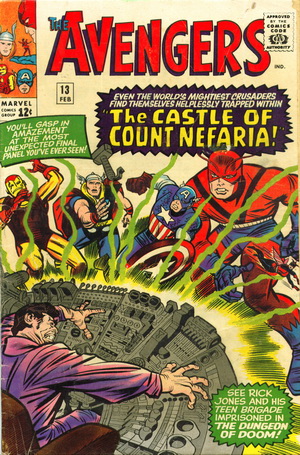
AVENGERS #13

“The Castle of Count Nefaria!”
Script: Stan Lee
Pencils: Don Heck
Inks: Dick Ayers
Letters: Artie Simek

IN A NUTSHELL
Count Nefaria, leader of the Maggia crime cartel, is angered by disruptions caused by the Avengers, so he arranges a trap. While they stay at his castle as guests, Nefaria captures the teen brigade, then sends duplicates of the Avengers to declare war on America. When the real Avengers depart the castle, the military attacks them. The Avengers deduce that Nefaria is up to something nefarious, and return to the castle to defeat him. However, during the melee, Wasp is gravely injured by a bullet.

WHAT’S HOT
HECK YEAH! On the splash I discover that the “Somewhat Distinctive Art” is done by Don Heck, and right away, I’m thinking, Heck yeah! One of my favorite artists so far. At least the women will not look hideous.

TECHNOLOGY MARCHES ON. Nefaria has a holographic zoom meeting with the American crime lord, then later uses his 3D printer to make lifelike images of the Avengers. All this, and it’s still only 1965!

DUNGEON MASTER. You know Nefaria is a super-villain, not only because of his nefarious name, but also because his castle contains so many dungeons they are labeled A through at least K. This guy is not kidding around.

WHAT’S NOT
BEDPAN DUTY. As the story opens, our mighty warrior superheroes, are catching fur thieves. Really? Where are the police? Or, at the very least…Spider-Man should be taking care of this!

MAGGIA. The world-wide crime cartel is MAGGIA, apparently a takeoff on the MAFIA. But nowadays, I’m thinking…just remove that extra G and I in the middle and what do you have? Just saying…

CHRONOLOGY ISSUES. How much time passes during this story? Right in the middle, we have to stop for Count Nefaria to disassemble his European castle, load it on to a fleet of cargo ships so it can make a transatlantic trip before being rebuilt on the other side. At one point “a matter of weeks” is mentioned, but surely an enterprise this complicated would be more time-consuming than that! And the real question: while all this castle-moving is going on, what else is happening? I don’t imagine the Avengers sitting around twiddling their thumbs as they wait for the Count to set up his new domicile.

CAREFUL WHAT YOU WISH FOR. Wasp is excited to meet Count Nefaria because he is rumored to be “positively fascinating.” This girl seriously needs to upgrade her standards!

WHEN SOMEONE TELLS YOU WHO THEY ARE, BELIEVE THEM. Before Wasp got herself all in a tizzy, she should have taken a hint from the Count’s unfortunate moniker: Count Nefaria. Does she not know what “nefarious” means? Apparently Thor does, since in this very story he uses the phrase “nefarious purposes.” Does no one even suspect that someone named “Count Nefaria” might not be such a great guy?

LOOSE THREADS. Nefaria thinks he’s pretty clever, and in fact his plan is not half bad, but… why didn’t he have a better strategy for dealing with the meddling Teen Brigade? Throw them in the dungeon! Really? Is that all you got, Nefaria? Sure, call them “dumb American kids.” So what? Seems those dumb American kids will be the end of you! So! Take that!!

WOMEN’S INTUITION. Iron Man says he thinks the Count has something to do with their recent trouble. Wasp says, “Call it Women’s Intuition if you want, but I feel the same way.” Sweetheart, no one is going to call it Women’s Intuition when Iron Man said it first.

ARTIFICIAL CLIFFHANGER. In the last panel we discover Wasp has been hit by a stray bullet and is now unconscious, clinging to life. Not only did this action take place off-screen, but it’s also described as “a one-in-a-million chance.” Stan’s not playing fair with his readers, as he tries too hard to make this a two-part story.

Want to read this comic on your computer? Marvel has a scan!
Want to own this story? Buy the Masterworks!
Posted in Avengers, Captain America, Daredevil, Doctor Strange, Fantastic Four, Human Torch, Iron Man, Meanwhile, Sgt. Fury, Strange Tales, Tales of Suspense, Tales to Astonish, Thor | Leave a comment

AMAZING SPIDER-MAN #21: Why Must I Be a Teenager In Love?

Published: February, 1965

Published: February, 1965

“Where Flies the Beetle…!”
Script: Stan Lee
Art: Steve Ditko
Letters: Sam Rosen

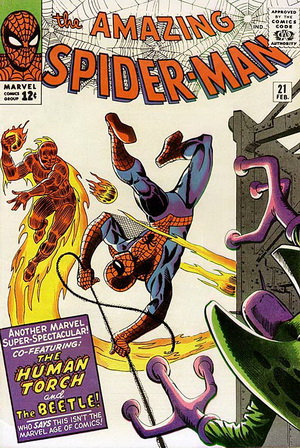
Okay, let’s get the boring stuff out of the way, so we can quickly dig deeper into what’s really happening in this story. The Beetle is released from prison and plots revenge on Torch by kidnapping his girlfriend, Doris Evans. Somehow (don’t ask…) Spider-Man gets involved in this whole thing, and there’s this whole thing where Torch and Spidey fight the Beetle, and sometimes each other, but in the end, all is well.

Which is fine, I suppose, but nowhere near as interesting as the many questions raised about the two teenage couples having to endure this fiasco.

DORIS LOVES JOHNNY…OR DOES SHE?
Johnny and Doris are most prominently featured, and the whole time I’m watching them, all I can think is, “What does Johnny see in her?” Sure, she’s shapely, and her facial features are no less attractive than any of the other female characters in these early Marvel Comics (which is not actually saying much, unfortunately…), but Doris is the most domineering and disagreeable girlfriend any guy could have the misfortune to hook up with—never mind a superhero guy, who deserves much better than this.

The oddest thing about this pairing is that Johnny IS the superhero that Doris so strongly objects to! She’s extremely self-centered, more concerned about whether or not she and Johnny can get to dessert in a restaurant than she is about the poor crime victims who need the Torch’s assistance. If she had her way, Johnny would never be Torch again. Is it a bridge too far to say on some level, Doris despises who Johnny is, at his core?
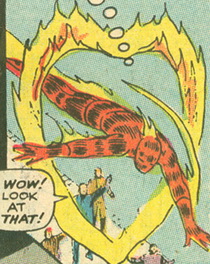
Then, explain this to me: Because Johnny is one of the rare PUBLIC superheroes, Doris knew what she was getting, when she started going out with him. This information wasn’t sprung on her AFTER she was hopelessly hooked on his good looks and charm. Sometimes, girl, honestly, you get what you pay for.

So what DOES Doris see in Johnny? Good looks and charm, apparently, and I’m guessing as a superhero, he’s quite popular in high school. Is Doris really just about going out with the captain of the football team? That’s my sorry opinion of her, that she is the most shallow teenage girl you could ever meet.

Obviously, I am NOT on Team Doris. Never liked her, and after reading this story, like her even less. (Which, by the way, isn’t it odd that we find out so much about the Johnny/Doris relationship in a Spider-Man tale, rather than a Fantastic Four or Torch story?)

Ultimately, the best part of this story is seeing Johnny pooh-pooh Doris’ call for help. She deserves this ridiculing. And in the end, Johnny teases her with, “You don’t mind me being the Human Torch at all…when you’re in trouble!” But will this experience change her view of superheroes? I would guess…NOT.

JOHNNY LOVES DORIS…I THINK…
On the other side of this equation, inexplicably, with all the mixed messages Doris is sending Johnny, at one point, he says, “She sure is a great gal, even if she DOES have that nutty prejudice against costumed crime-fighters!” Sorry, I beg to differ. I haven’t seen anything about Doris that makes me suspect that she is a “great girl.” And I don’t understand why he isn’t more disturbed by her “nutty prejudice” against the one quality that most defines him.
Because Torch is so much a part of who Johnny is. He revels in his do-gooding, as much as he revels in his Torchy showmanship. Well…okay. Johnny probably enjoys showing off more than the average superhero. And he can impress everyone on the street below…except the one girl he’s going steady with. Why doesn’t that eat him up?? Is HE shallow too?? Merely enthralled by her well-drawn figure and Kirby-esque facial features? Oh, tell me it isn’t so!

DORIS LOVES THE PETER PARKER…OF HER IMAGINATION
But let’s move on.

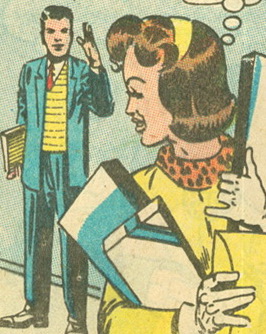
By an extreme coincidence, Doris happens to meet Peter Parker, whom she instantly labels a “nice, sweet, gentlemanly boy!” After a few minutes conversation she is further impressed that he is “so quiet, so soft-spoken, so gentlemanly!” (Yes, she says “gentlemanly” again.) Science major, cultured, down-to-earth…everything Johnny Storm is NOT.

So, is Doris thinking she would much rather have a boyfriend like gentlemanly Peter Parker, rather than wild and crazy Johnny Storm? If that’s what she’s really thinking, then…do it, girl! Cut Johnny free! Let him get on with his life, without having to put up with your demeaning insults and demands.

Of course, when I stop to think about it…Doris doesn’t really want a boyfriend like the character she perceives Peter Parker to be. No, Doris and Johnny are too much alike, and maybe that’s why they stick together. They are both strong-willed personalities, vivacious, confident, energetic. In some weird way, they thrive on the drama and tension inherent in their relationship. Otherwise, why would they still be together?

BETTY LOVES PETER, BUT FEELS UNWORTHY
But let’s leave Johnny and Doris for a while and take a look at Betty and Peter. Oh, poor Betty. Every time I see her, the girl is practically in tears, thinking Peter is cheating on her. Unlike Doris, Betty has absolutely NO self-confidence. But she does have an extremely active imagination. She can take a circus ticket, or a piece of idle gossip heard on the street and turn it into confirming evidence that Peter doesn’t love her, he never loved her, and he’s going to dump her. Any minute now.

A few issues back, Betty started going out with a fellow named Ned. Before you could say “Amazing Spider-Man,” Ned was flying off to Europe, so now he’s out of the picture. But Betty never loved Ned. The strongest emotion she ever felt regarding Ned was disappointment over the fact that Peter did not appear at all jealous that she was dating him.
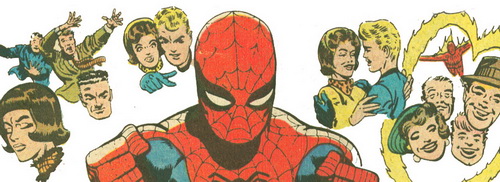
Obviously Betty loves Peter. But not in a good, healthy way. No, it’s in the sit-by-the-phone-and-cry-until-he-calls way. I would love to know Betty’s background, what has made her so insecure.

PETER LIKES BETTY, BUT THE BOY HAS A LOT ON HIS PLATE
And Peter likes Betty. I think it might be a bridge too far to say he “loves” her, but he cares about her, and wants her to be happy, wants them to be happy together…but that’s difficult, when Betty keeps flying off in fits of tears every other issue. Peter must be thinking, “Women! I’ll never understand them!”

But then, there’s a lot Peter doesn’t understand. Why is it that everyone loves Torch, but runs away when Spider-Man shows up? Why is his boss J. Jonah Jameson always yelling at him? Girl trouble, money trouble, school trouble, bully trouble! No matter where he looks…trouble! Between Peter and Betty, it’s hard to know who has more distressing issues.

LOVE IS A MANY TANGLED THING
So, let’s recap:

  • Doris and Johnny are a hot mess. Betty is a hot mess. And Peter’s entire life is a hot mess.
  • Peter and Johnny are as opposite each other as Betty and Doris are opposite each other. And when you put them all together, the couples they form are equally opposite each other!
  • Johnny and Doris are perhaps too much alike…but is that really working out for them? And Peter and Betty might have a chance at success…with professional counseling. Or at least a good self-help book.

Oh, what a web of interpersonal relationships are woven in this installment of Amazing Spider-Man! The angst! The tears! The bitter resentments and foolish games!

Makes me glad I’m not a teenager anymore.

Want to read this comic on your computer? Marvel has a scan!
Want to own the story? Buy the Masterworks!
Posted in Spider-Man | 1 Comment

TALES TO ASTONISH #64: Love Is a Many Splintered Thing

Published: February, 1965

Published: February, 1965

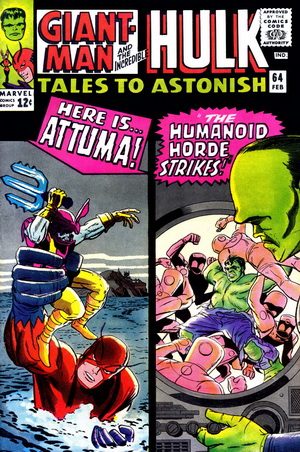
“When Attuma Strikes!”
Script: Leon Lazarus
Pencils: Carl Burgos
Inks: Paul Reinman
Letters: Sam Rosen

Remember that famous scene from the 1985 Arnold Schwarzenegger movie Commando, when Rae Dawn Chong gets out of the way of the two battling hulks, exclaiming “I can’t believe this macho bullshit!”? At the time, that line resonated for me, and even now, I have to admit, sometimes while reading Marvel Comics, I fast forward through the superhero battles. (“Fighting ensued…macho bullshit…ho-hum…”)

Honestly, I’m mostly here for the Soap Opera.

But when I sat down to read this month’s Giant-Man, simply looking for some easy “Hot” and “Not” comments for a Meanwhile post, I soon found myself unable to proceed, because the Hank/Jan relationship was reaching deep down into my psyche and churning up such uncomfortable feelings. Maybe a little more soap opera than I had originally bargained for.

AS YOUR WORLD BURNS
You see, I haven’t always been married to Russ. In a previous life, I was married to someone who, though not physically abusive, could probably have been described as at least borderline emotionally abusive. With him, I always felt I had to justify my existence. I don’t really care to rehash all the details, but I will mention that at one time I kept a list of the ten most hurtful things he had ever said to me, and though most of them have thankfully faded from memory, for some reason these two still ring clear as a bell: as a stay-at-home mom, I was sometimes told, “Housework! It’s so damn easy,” and when the kids got older and I began looking for a job, I was told, “No one will ever hire you.” So. Emotionally abusive…or not? You decide.

And now, here I am, reading this month’s Giant-Man, and Hank is pretty much treating Jan like total crap. I have to admit that at first I was not really that disturbed by his over-reaction to Jan dropping the test tubes. Sure, he yells at her, but I understand. He’s frustrated about having to backtrack in his all-important, all-consuming experiment. It’s a gut reaction, a natural reaction.

But after his outburst, he immediately goes right back to work, completely ignoring Jan. And again, I give him the benefit of the doubt, thinking, “Okay, yeah, he’s being a jerk, but…his work…the experiment…” For reasons I don’t completely understand, I’m still giving him a pass. And not feeling comfortable with myself about that.

CRY ’N’ HOPE
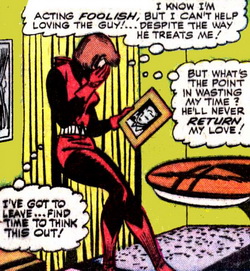
But then we come to Jan’s reaction, and now… KA-BOOM! The poor girl is reduced to tears, packing her bags. Really?? I had no idea it was this bad! But then I began to think: she’s been hankering after Hank since issue #44, and he occasionally throws her a bone, gives her a small small sign that he might feel the same way, but overall he’s hardly Mr. Romance. So hot and cold. I don’t blame Jan for wondering if this is really going to work out.

But then she says, “I love him,” and now my stomach is churning, and I have to wonder WHY in the world does she love this jerk, who cares more about his lab equipment than he cares about her?

We see this sometimes in books, movies, TV shows…and yes, even comics. (Remember poor Dorrie, so willing to accommodate herself to Johnny’s temper?) When this sort of thing happens in literature and entertainment, it’s good for storytelling, good for drama. But too often, we see it in real life. And I have no patience or understanding—in literature, entertainment, or real life—for the woman who permits herself to be emotionally abused.

And then I remember…once upon a time, that woman was ME. So it makes me wonder if that’s why I have so little patience for it. When I look back at the person I was all those years ago, I have to wonder, why did I allow myself to be treated that way?

ALL FOR MY CHILDREN
My situation, though, was significantly different from Jan’s. First, I was married, there was a legal bond; Hank and Jan have nothing like that. Also, while Jan may have the social mores of the 1960’s telling her to “stand by her man,” for me, the 1990’s were a lot more liberal. But the church I was attending at the time was anything but; divorce, under almost any circumstance, was a big no-no. I’d made a commitment, and I was determined to see it through.

But it was more than that. Not only was I was married, but I also had two kids—and no huge pile of money (as Jan does…she’s an heiress, remember) if I ever should think about wanting to escape. There was no practical way to get out of this, even if I wanted to—and in my first husband’s defense, he was a really good dad to the kids. Basically, if I cared about my kids (which I did), I was stuck. At least for the time being.
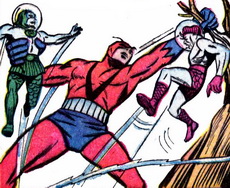
But getting back to our story, while I’m applauding Jan’s decision to leave, to no longer allow herself to be treated so shabbily, at the same time I’m faulting her for still loving the man who treats her so shabbily.

But she does indeed leave Hank, and it’s only when she’s gone that he emerges from his scientific fugue and finally realizes what a dick he’s been. (Well… “I guess I have been pretty hard on her lately” will have to suffice for his moment of self-revelation).

LOVE OF FIGHT
In between all this soap opera there’s some predictable comic book action between Giant-Man and Attuma (“Macho bullshit,” anyone??)—but it’s totally incidental, because the real story is that Hank and Jan finally get back together, and hopefully, he won’t take her for granted, in the future.

Human nature being what it is, though, I’m hardly confident this one incident will be the last of its kind for Hank and Jan. I don’t know what lies in store for them—and please don’t spoil me—but I suspect that, due to their superhero obligations, they will remain together a long time. And because of the Marvel Cinematic Universe, I also feel pretty sure that they will eventually marry and have a daughter named Hope, who will also become a superhero. At least that’s what will happen if I can believe the happy ending I see in the movies.

THE GRASS IS GREENER
My own story also has a happy ending. Once the kids got older and began middle school, I went back to work. (See! Somebody did hire me!) I started making a decent salary, and more to the point, I got to where I could support myself and the kids, if I had to.

And eventually I had to. Because, like the superhero whose nobility (or church affiliation) does not allow them to actually kill the super-villain, I was provided an “out.” In the same way that some strange plot twist, or another character, or simply “Fate” steps in at exactly the right moment, in the end, it was my husband’s decision to leave the marriage, thereby absolving me of any religious guilt or wrong-doing in the matter.

These days I’m much more liberal. The kids are grown and doing fine. Russ and I found each other, and I’m much too busy being happy to waste precious emotional energy pondering the plights of my past. Until a comic book story like this comes along to uncomfortably remind me of what has been, and make me thank God for where I am now. As C.S. Lewis, one of my favorite authors, titled one of his books, I have been Surprised by Joy.


“The Horde of Humanoids!”
Script: Stan Lee
Pencils: Steve Ditko
Inks: George Bell
Letters: Artie Simek

EDGE OF PLIGHT
Which leads me to the next story in this issue. Advancing into the next chapter of the Banner/Hulk continuing saga, I was greatly surprised by three particular plights detailed in these pages.

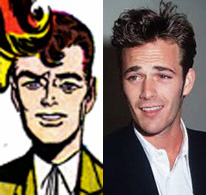
First, to get Banner out of his difficult situation, Rick Jones boldly visits the President of the United States to appeal for help. I kid you not! We never see the President’s face, but every indication is that it’s LBJ, and that Jones shares Banner’s entire story with him! Really! How outrageous is that? So now, the President of the United States is in on the big secret known only to Banner himself and teenage sidekick Rick Jones (who, by the way, if I was casting this story in the early 1990’s, I think I probably would have tried to get Luke Perry to play Rick Jones. What do you think?)

But apparently Rick’s clever scheme actually works! The president stretches his presidential muscles, and charges against Bruce Banner are dropped. Whew! That was easy!

But that’s not all! You know Hulk cannot be kept at bay for long, and a good deal of newsprint is given over to the giant angry green one fighting a horde of pink plastic humanoids, who cannot die, or suffer injury, so…how in the world shall we ever get out of this? The writers realized they were painting themselves into a corner, because on the last page, they once again pull out the preposterous bit of logic that when Hulk’s pulse rate goes too high, he is in danger of changing back into Banner. Which of course makes no sense at all. So I’m surprised that we’re once again seeing this bit of nonsense. It reeks of literary desperation.

DAYS OF OUR LIES
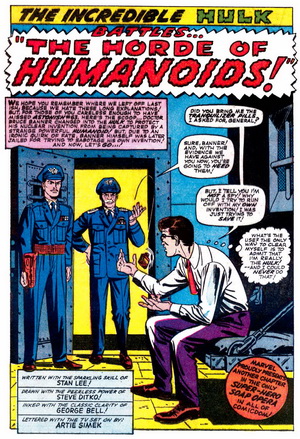
But here’s one more surprise, which reeks of hyperbole on overdrive, as I’ve never seen it before. On the splash for this Hulk story, the editor informs us that this title is “the only super-hero soap opera in all of comicdom!”

HELLO! Haven’t I just gone on, for over a thousand words, commiserating how the relationship between Hank Pym and poor little heiress Janet van Dyne stirs up too many difficult memories of my own unhappy first marriage? If that’s not soap opera, what is?? I mean, we all know that though the Hulk title does on occasion veer into soap opera, it is by no means the most soap operatic, never mind the ONLY super-hero soap opera.

So why do the writers feel compelled to make such an outlandish statement that can instantly be challenged and disproven? It’s almost like they don’t care what they write, as long as it appears larger-than-life, and evokes strong emotions in their audience.

But then…isn’t that exactly the essence of soap opera?

Want to read this comic on your computer? Marvel has a scan!
Want to own the Giant-Man and Wasp story? Buy the Masterworks!
Want to own the Hulk story? Buy the Masterworks!
Posted in Giant-Man, Hulk, Tales to Astonish, Wasp | 2 Comments