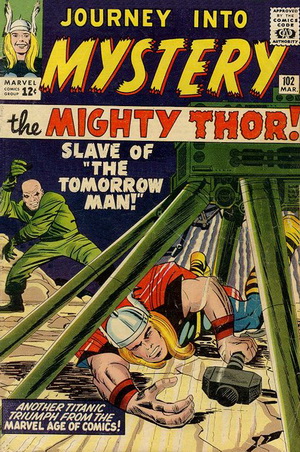
Published: March, 1964
Script: Stan Lee
Pencils: Jack Kirby
Inks: Chic Stone
Letters: Art Simek
“Death Comes to Thor!”
Script: Stan Lee
Pencils: Jack Kirby
Inks: Paul Reinman
Letters: Art Simek
You wouldn’t think of a 12¢ comic book from the 1960’s as a religious tract for gleaning great spiritual truths, but reading Journey into Mystery #102, I’m impressed with the enormous issues addressed in these two stories. If you ask yourself the deeper questions, you realize Marvel comics go way beyond “Me good guy, you bad guy, me beat-em you up.” Guess what, folks! I think we’re supposed to learn something here.
Sometimes, when comic stories are meant to teach us something, the lesson comes down hard as Thor’s hammer. Ouch! (Remember Torch’s motivational speech at Peter Parker’s high school? “Don’t be discouraged if it sometimes seems tough! Never give up! Never give up!!”)
We start with “Slave of Zarrko, The Tomorrow Man!” in which Thor has another encounter with Zarrko, from the 23rd century. We’ve already established, during their first meeting in Journey into Mystery #86, that the future is a place of lollipops and butterflies, where “Mankind has abolished war and scrapped its weapons! Peace and contentment prevail throughout the globe.” Only Zarrko retains evil in his heart. And as fate would have it, the single evil person on the planet is not a lowly janitor at Global Scientific Industries and Inventions, Inc., but instead, one of the head scientists!
Here in the future, the only person capable of building a time machine also happens to be the meanest SOB on the planet. And now, with his memory freshly restored, courtesy of the meddlesome Loki, Zarrko travels back to the twentieth century to subdue and enslave his enemy, the mighty Thor.
But wait! How can this be? As you recall from our last outing with Thor, as a punishment for his surly insistence upon marrying the mortal Jane Foster, father Odin reduced Thor’s powers by half. But now, doddering old fool of a god that Odin is, he’s forgotten this little fact, and is “sorely grieved” to see Thor surrender to Zarrko rather than risk pillage of the entire 20th century.
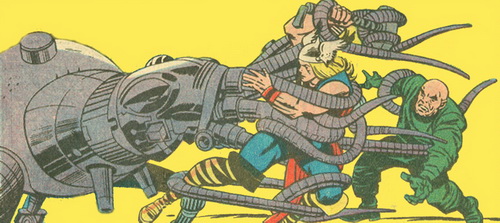
So that’s how this all gets set up. Noble Thor feels bound to keep his promise to Zarrko, who employs him as “muscle” to terrify the locals and force the World Council to listen to his demands. Sticking strictly to the letter of the law, Thor assists Zarrko, but only so far. At their meeting with the World Council, in a sterling performance as a 7th grader, Thor passes a note that says, “Hey! Remember me? I helped you out last time, I can do it again. Just let me do it MY WAY.” You can almost hear Frank Sinatra singing in the background as Thor and Zarrko battle a giant Maximum Security Octi-Robot, and “C-Bomb” to reach the Master Machine which controls the entire world. The moment Zarrko stands in front of the Master Machine, he releases Thor from his vow, and of course Thor immediately battles and captures him.
The people of the 23rd century are grateful to the point of gushing (“To YOU this is probably just another one of a thousand victories…”), but Thor is above such accolades, and the handsome, dramatic God of Thunder slips back through the centuries to his own time.
Meanwhile, Odin is pleased with Thor’s performance, but Loki…not so much. He swears that sooner or later he’ll get that accursed Thor!
But that’s a tale for another day. The question now is: What have we learned from this tale? Easy! That good will always triumph over evil. Right? Yeah, yeah, we get it, sure. But that’s not what I’m talking about. The main thing I learned from this story–as we’ve already been told in Journey Into Mystery #86, not to mention every Star Trek episode or movie ever produced–is that in the future, everything will be PERFECT. People have finally EVOLVED, and learned how to be GOOD. No one is evil. Except, of course, that rare individual who is evil, thus giving heroes something more to do than shine the metal feathers on their helmet, or perform extensive tests on anti-matter engines.
But, in general, society is so wonderful, there is no longer a need for any of those pesky inconveniences we currently suffer–you know, little things like locks on doors, lie detectors, passwords, the judicial system and oh…did I happen to mention? POLICE. No weapons, no police force. That’s what we’re told.
Okay, I have to say: I’m having a hard time with this concept. Because in a story based on the premise that in the future there are no weapons or police, I practically need my fingers and toes to count the references to law and order.
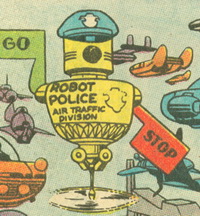 First, we’ve got a “robot police, air traffic division” to direct traffic. Apparently, we can’t expect people to obey simple traffic symbols like stop signs and lights, so a ROBOT wearing a 20th century policeman’s cap spins around in the middle of traffic, lifting up red and green arms that say “Stop!” and “Go!”
And then, when the uniformed “Techni-Guards” arrive, they carry handheld devices that look suspiciously like GUNS. Of course, as the narrator reminds us, “there is no official police force, because there is no crime,” but the techni-guards PROTECT the machines which serve mankind.
Protect them from WHAT? Or whom?
But if those handheld devices that look like guns are merely “instruments” to control defective machines, why do they have to look so much like guns? And if they’re not guns, why does Zarrko command Thor to destroy them? “They cannot threaten Thor!” Zarrko exclaims, but immediately follows with, “Destroy them, Thunder God!”
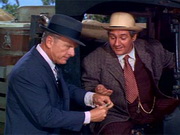 Methinks you are probably making your own connections about now, but my mind flies to a favorite Green Acres episode, where Oliver Douglas has a chicken that lays square eggs, and the conniving traveling salesman Mr. Haney informs him, “Any chicken that lays square eggs is absolutely worthless! And I’ll give you twenty dollars for it.”
You can’t have it both ways.
But let’s move on. Next we run into the World Council in a suspiciously U.N. type setting–“the men who make the laws which the machines carry out.” Correct me if I’m wrong, but wouldn’t those men be…computer programmers? What kinds of laws are they making? Traffic laws? Why do we need a “WORLD Council” to make traffic laws?
And if there is no crime, why do we need a “Maximum Security Octi-Robot” which is also described as a “Protecto-Robot” that attacks and emits poisonous gas? Apparently someone in this crimeless universe thought ahead enough to imagine a time when bad guys would need to be dealt with.
And why is there a torpedo-shaped C-Bomb, which is actually an “instant-PRISON”? If there are no bad guys, why do we need a prison? Why would the Master Machine have this device to protect itself from an “attack” in a totally peaceful world?
Incidentally, this “C-Bomb” is not the same “C-bomb” which Zarrko stole from the 20th century in Journey Into Mystery #86. That C-Bomb was a Cobalt bomb, capable of mass destruction. This one merely makes an “instant prison.” So you can capture bad guys.
Of which there are none.
Sigh…I think you get the point.
I’m done here. “A” for effort to Stan Lee, who “cunningly conceived” this tale, for trying so hard to bend over backwards to give us a society overflowing with universal peace. I got a good chuckle out of the gallant effort, but this story reeks so badly of Star Trek idealism, I come away from it more convinced than ever that no matter how hard you try, no matter how fervently you hope, as long as human beings are in charge, Utopia simply ain’t happening.
But here’s the other side of the coin.
In our second story, from the Tales of Asgard series, “Death” Comes to Thor! Death is in quotes, because he doesn’t actually die, but he does have a brush with “Death” that changes his destiny.
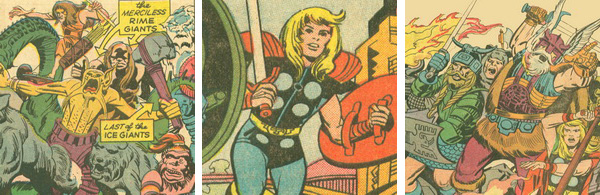
 Determined to lift Mjolnir, teen Thor consults the Three Fates, who reveal that he will win the enchanted hammer, but he must first “meet death.” Thor barely has time to mull this over, before hearing that Sif has been taken prisoner by the Storm Giants. (And no, she’s nothing like the warrior we’ll eventually know in film. As Russ says, “Forget you ever saw her.”)
Enraged by this turn of events, and intent upon rescue and revenge, Thor suddenly lifts the hammer and rushes out on his mission. King Rugga tells Thor that Sif has been given to Hela, the Goddess of Death. Thor hurries to Hela and offers himself in place of Sif. Hela is so touched by “a life which is so young, so brave, so noble,” that she lets them both go free.
End of story. Quick, clean, easy. But of course, you see what’s happening here.
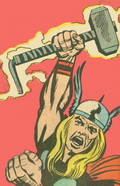 Remember the inscription on Mjolnir? “Whosoever holds this hammer, if he be worthy, shall possess the power of Thor.” The moment Thor was willing to sacrifice his life for another, he became “worthy.” THAT’S the key! Not physical strength, bravery, or intellect—it’s all about love for his fellow man, and the willingness to sacrifice. I don’t know if Norse mythology includes stories of a sacrificial god, but many religions, belief systems and folklore enjoy this cornerstone, not least among them Judeo-Christian theology.
The common man is never going to be spiritually good enough to “evolve” to a state where police, law, judges, and external motivations for virtuous behaviors will no longer be required. We can kid ourselves about our advanced spiritual enlightenment, but even as we do, we’re always going to lay up some “Protecto” devices, just in case. And even then, that enlightenment promises nothing beyond the grave.
The human race has always needed, and will always need, a worthy son of a god to rescue it from the hands of Death. It’s no accident or coincidence that this story keeps getting told over and over again, down through the ages.
It’s also no accident or coincidence that teen Thor, from the goodness of his godly heart, is able to accomplish what has eluded the whole of humanity for thousands of years.
In the first story, Stan, like Star Trek, got it wrong. In the second story, he got it right. We can’t rescue ourselves from who we are, from our basic human nature. We need a hero.
That’s what I learned today, reading comic books.
| Want to read this comic on your computer? Marvel has a scan! Want to own this story? Buy the Masterworks! |
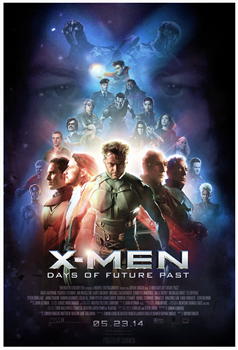 So I thought I’d review X-Men: Days of Future Past in the style of my “Meanwhile…” posts, where I compare what’s “Hot” and “Not.” But in this case, I’m calling my categories “LOVED IT!” and “Not so much…”
 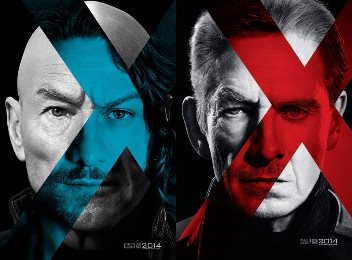 In some ways, First Class was even better than some of the original movies, and one of these days I would love to get around to reviewing First Class as well.
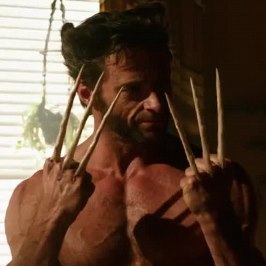 transported back to 1973, unapologetically introduces himself as being from the future. And then he goes on to tell everyone he meets that he’s from the future.
 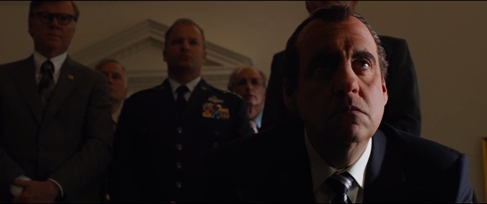 Historical events from 1962 are woven into the plotline of X-Men: First Class, and now we find ourselves eleven years down the road. The events of 1973 are not strictly historical, but the mindset, the music, fashions, and grainy news footage all contribute to the feel of the era. Several historical references are played for laughs, and one or two fit into that “Wouldn’t it be cool….?” category. It was also cool that they had a fairly good Nixon lookalike (Mark Camacho) who delivers his “My fellow Americans,” line with stirring conviction.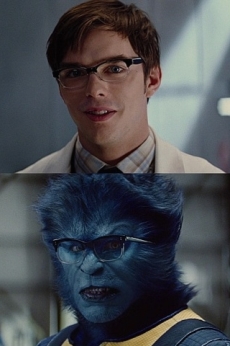
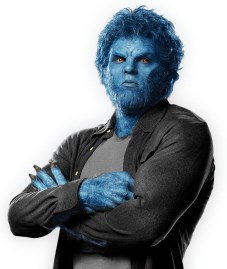 Loved Nicholas Hoult as Hank McCoy in X-Men: First Class, and love him even more in Days of Future Past. As a human, he’s adorable, and as Beast, this second appearance finds him looking a little rougher around the edges. And that’s a good thing. Because he is, after all…a beast…
 understanding all the ramifications of time travel. However, I don’t think I’m alone in this, and perhaps I need to share my dunce cap with the writers and producers of this movie. They try, but paradox will rear its ugly head now and then.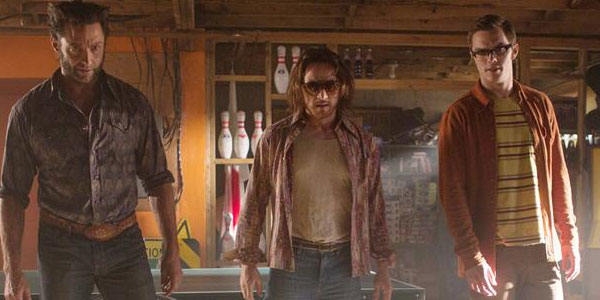
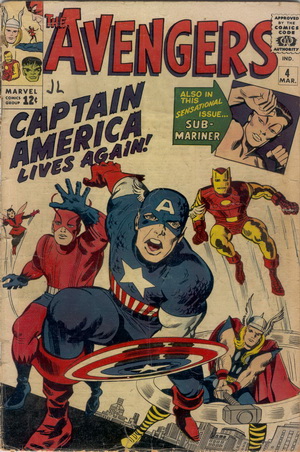
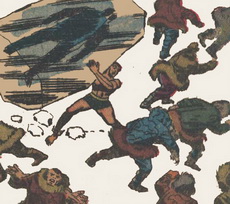 Namor pitches a fit and smashes the frozen idol to the ground. Then he leaves, never realizing his single, reckless action inadvertently serves as the catalyst for the strengthening of the Avengers.
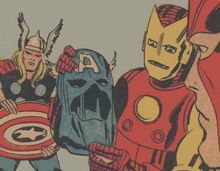 In Avengers #4, the Avengers rescue the shadowy, frozen figure from the depths of the ocean, and as the ice melts away, they discover the shield and the mask, quickly realizing what they’ve discovered.
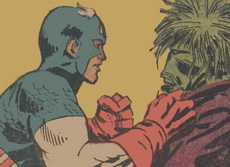 Seems the Avengers were turned to stone by a stranded alien who only wants to “phone home,” but must resort to defending himself by turning people to stone. In a neat twist, this alien, whose “name would be meaningless to you as earth tongues cannot even pronounce it,” has been the inspiration for the Medusa myth, frightening people with his long scraggly hair before zapping them with his stone-ray gun.
 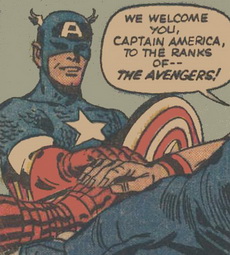 So he does…and they do…only Namor and some undersea warriors crash the party. The expected battle ensues, till The-Alien-Formerly-Known-As-Medusa blasts off in his newly repaired spaceship from the middle of the ocean, causing volcanic waves that scatter the clashing combatants.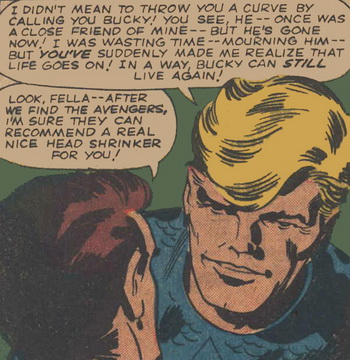
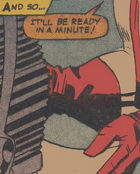 But let’s give Cap a little leeway here, shall we? His “past” took place yesterday. He’s suddenly been transplanted 20 years in the future, where he’s alone (or, if he finds the time to track down anyone he used to know, they’ll either be either dead, or really old, and that’s going to cause yet another shock). Cap is trying to cope with an impossible situation, and if it helps him to pretend that Rick Jones is his old pal Bucky…then, let’s just let him. Right? It’s not hurting anyone, and maybe it makes him feel better.
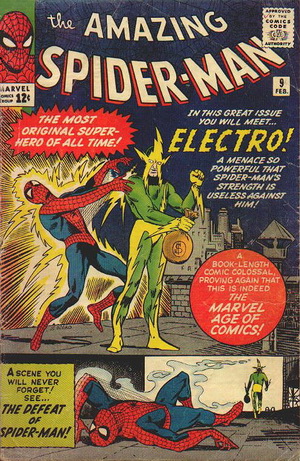 “The Man Called Electro!”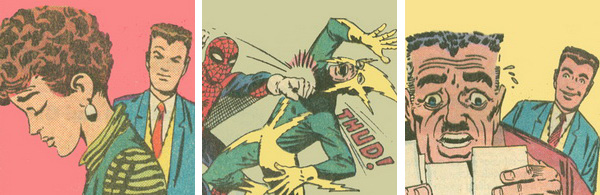
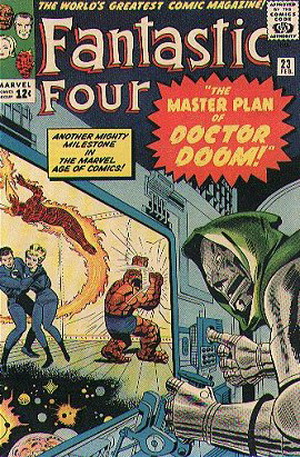 “The Master Plan of Doctor Doom!”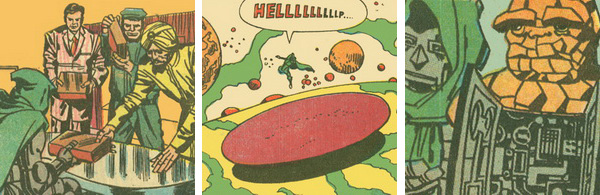
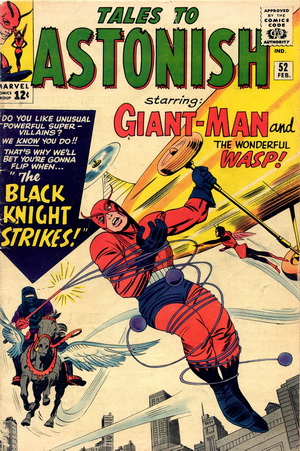 “The Black Knight Strikes!”
 This time around, Wasp tells a tale to orphans about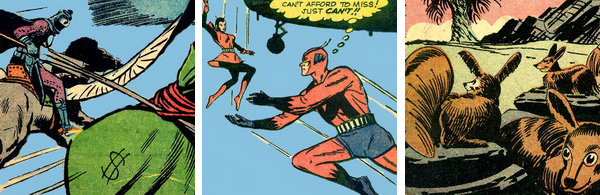
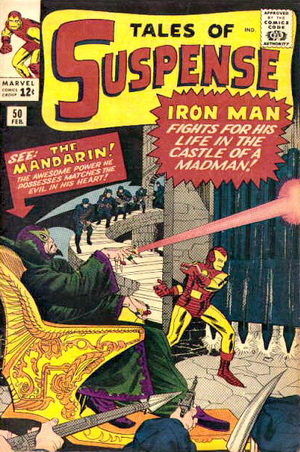 “The Hands of the Mandarin!”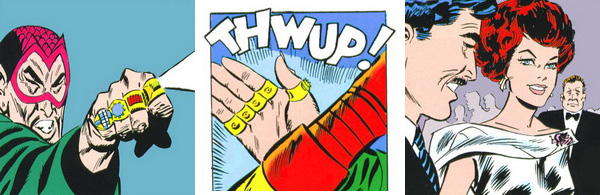
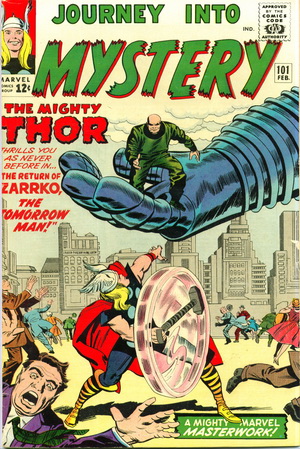 “The Return of Zarrko, the Tomorrow Man!”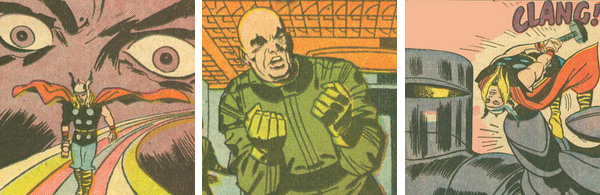
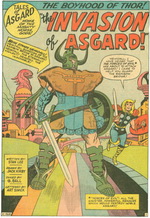 “The Invasion of Asgard!”